Listen here
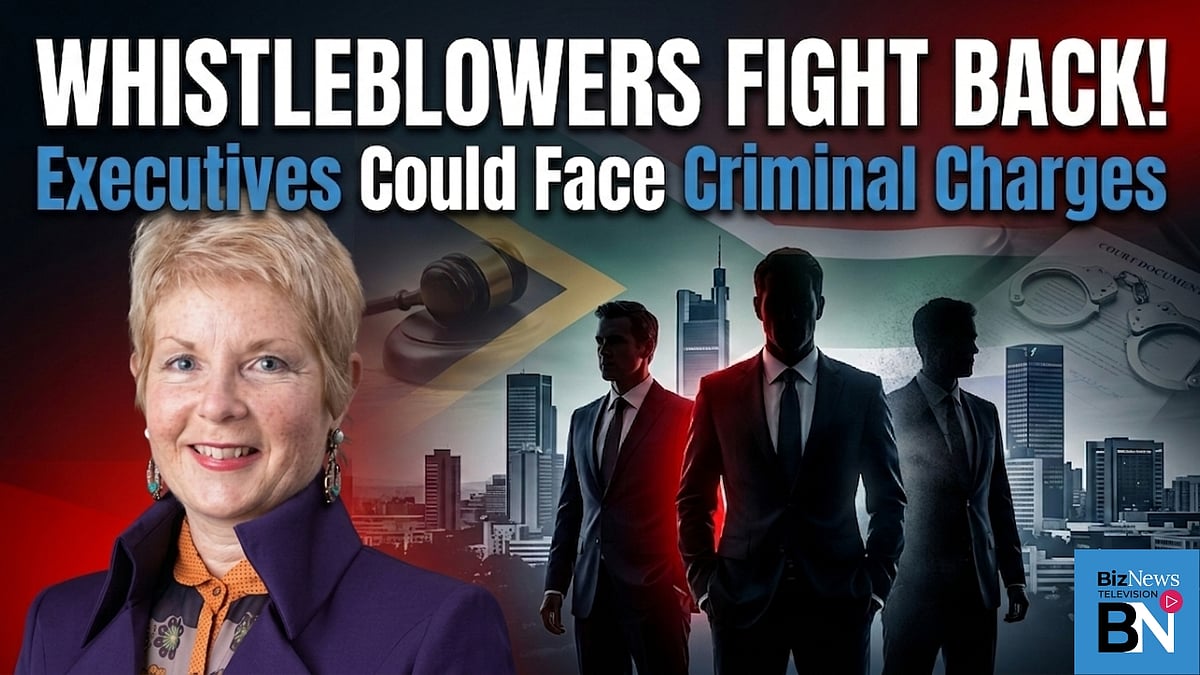
In this interview with Chris Steyn, South Africa’s first high-profile whistleblower, Wendy Addison, describes scorched earth legal action being launched to ensure executives face criminal accountability for failing whistleblowers. Addison, a Council of Europe Whistleblowing Expert, confirms that a criminal docket has been raised against a top South African corporation and its directors “to criminalise their lack of accountability, their lack of willingness, the way that they have performed in an unethical way to silence the individuals trying to report a good faith and legitimate disclosure”. The case – involving two of the whistleblowers Addison supports – could be a watershed, particular for whistleblowers in the financial industry. Addison also describes her own harrowing whistleblowing journey that led to her founding SpeakOut Speak Up: “I lost my job. I lost my career. My life and the life of my 12-year old son at the time was threatened. So I fled to the UK…I ended up on the streets, squatting in houses, begging on the streets with my 12-year-old son…I only got off the streets six months later when I got a call from the South African investigators who then subpoenaed me back to South Africa…I wanted to secure justice against the corruption – and it took me 11 years, but the individuals, the CEOs…actually went to jail.”
Sign up for your early morning brew of the BizNews Insider to keep you up to speed with the content that matters. The newsletter will land in your inbox every morning on weekdays. Register here.
Support South Africa’s bastion of independent journalism, offering balanced insights on investments, business, and the political economy, by joining BizNews Premium. Register here.
If you prefer WhatsApp for updates, sign up to the BizNews channel here.
Edited transcript of the interview
Chris Steyn (00:01.698)
South Africa’s first high-profile whistleblower, Wendy Addison, vows scorched earth action against executives and officials who fail other whistleblowers. She’s with us now. Welcome, Wendy.
Wendy (00:16.207)
Welcome, and thank you so much for that welcome, Chris. It’s good to be here. And it’s the first time I’m being interviewed by you, so it’s an absolute pleasure.
Chris Steyn (00:25.324)
No, it’s an honour. It’s always an honor to interview a whistleblower of calibre. Thank you. Wendy, please tell our viewers how come you founded Speak Out, Speak Up, and how you ended up being a Council of Europe whistleblowing expert.
Wendy (00:43.929)
I just wanna make clear at the get-go that really the genesis of my advocacy, which has been shaped by my experience as the whistleblower for what’s known as South Africa’s Enron, is to help people…
Wendy (01:12.749)
…within organisations who see something they think is unethical, want to speak up about it, don’t want to become a whistleblower, and how to guide them and to navigate the systems. And that support is there for both the individual, the ethical individual, and for the leadership of organisations, specifically in South Africa, where a lot of South African organisations I’m hearing don’t really want to encourage whistleblowing to be fair to them. How are they going to protect those whistleblowers? So the genesis of my advocacy is to help people navigate the skill of speaking up and listening up before going down the whistleblowing route, because that’s treacherous.
And when I get whistleblowers from all around the world reaching out to me, the first thing I say to them is, I wish you’d contacted me before you blew the whistle, because we’d have a better chance…people becoming entrenched.
So to go back to your lovely invitation about how did I become this person: I was the International Group Treasurer for LeisureNet Limited. I don’t know if people remember the Health and Racket clubs now owned by Virgin Actives. And there was endemic fraud and corruption where the joint CEOs were embezzling hundreds of millions offshore into a Jersey bank account. And I was met with a moral dilemma. Do I look the other way, mind my own business, or do I speak up about this?
And in those days, in the year 2000, there weren’t any Public Protection Disclosure acts in South Africa. So I understand that the act, the Protected Disclosure Act was built around the LeisureNet case.
So I spoke up anonymously to the South African Exchange Control Board, who invited me in to have an interview. And because some of their board members played golf with the corrupt individuals within LeisureNet, I wasn’t prepared to take that risk.
Wendy (03:39.437)
But I think also at the time, the King’s Corporate Governance Commission was coming in… corporate governance was coming into South Africa. And this particular agency was really, really keen to show that they were acting on any kind of disclosures. So they traced the phone call to the LeisureNet buildings in the main road in Wynberg.
And within a week, they did a dawn raid on the building itself: came in, men in black, black suits, SARS, KPMG, forensic accountants, Sonnenbergs, I think were the lawyers at the time, and basically said this company is going into an inquiry.
Naturally, and as the story goes for most whistleblowers, I lost my job, I lost my career, my life and the life of my 12-year old son at the time was threatened. And I determined that I needed to leave the country. So I fled to the UK.
Ironically ended up working for Richard Branson in a complete, complete ironical twist of fate. And I wasn’t aware at the time that Nelson Mandela had called up Richard Branson and put a proposal to him saying, we’ve got this company that’s going into liquidation. It’s a health company, it’s leisure, it’s your business if you want it. And Branson took the offer up from Nelson Mandela, like who wouldn’t, and he bought the Health and Racket clubs.
At the exact same time, I was sitting three floors down from him in his Notting Hill gate offices as his International Group Treasurer. And of course he had to get rid of me because there was no way he could have had me functioning as an international group treasurer when there was a whole lot of illegalities going on anyway with Branson and Gardener and Mitchell, the CEOs of LeisureNet at the time. So he fired me.
I ended up on the streets, squatting in houses, begging on the streets with my 12-year-old son. And, you know, it was an awful…
Wendy (06:03.926)
.. the tragic reality of what happens to truth tellers.
You know, nothing much has changed since Socrates spoke up against the government at the time, and was given a choice of hemlock, commit suicide, or stop speaking about the things that offend us.
And I only got off the streets six months later when I got a call from the South African investigators who then subpoenaed me back to South Africa and there began an 11-year journey.
For me, it was I wanted to secure justice against the corruption and it took me 11 years, but the individuals, the CEOs, …of Health and Racket clubs actually went to jail.
And I want to actually celebrate that moment, because I know of no other whistleblower in the world that has had the individuals who were behaving in a corrupt way actually go to jail. There’s never been a line in the sand.
Whistleblowers are left suffering in victimhood. Most people are damaged in some shape or form. I’m not saying that I am not. I’ve suffered terribly because of this. But I was able to reinvent myself.
And I was insanely curious about whether I was different to other people, whether the fact that I was a woman, did it make it easier for me to speak up to the group? Why didn’t my group of executives who were all really good men support me in speaking up? What was that about? So I began to study the human behaviour that either propels us to speak up or interrupts us.
And I met Dr. Phil Zimbardo, who did the Stanford Prison Experiments in the 60s. And he sponsored me to go to Stanford University to actually study this human behaviour.
Wendy (08:26.638)
And out of that, I built my company Speak Out, Speak Up.
And the full circle then goes back to not advocating for whistleblowing, but something healthier, something that has got longevity, sustainability, and that maintains our relationships with others and helps us actually make progress on things that matter at the same time.
So how do we speak up? How do we listen up before we push the button on the whistleblowing exit because it is an exit.
So that’s my background and how I got to be here and a little bit about who I am.
And I’d like to, you know, with your permission, Chris, talk about where I’m at at the moment with two South African whistleblowers in the financial industry.
Chris Steyn (09:23.948)
Yes, please.
Wendy (09:25.204)
… many years ago, four years ago, two South African financial industry whistleblowers, senior executives reached out to me and said, can you please help me? So I’ve spent many years walking alongside them.
And we are now in a very different position. And again, this speaks to something about the spirit of South Africans: the willingness, the appetite of the judiciary to think about things differently.
And I, my people that I’m working with alongside these two whistleblowers, want to flip the script. And the reason for that is there are many, talking shops, NGOs, charities around the world that put their heads together and with good intention talk about how do we protect the whistleblower. But let me tell you that protection of whistleblowers are words on paper and bullets have no respect for words on paper. And I’m speaking specifically about South Africa here.
And going back to the reluctance of organisations to encourage people to whistleblow because they cannot protect this whistleblower. And that is the reality of where we’re at.
So I want to move out of this talking shop of, my goodness, how awful this has happened to another whistleblower, wherever we are in the world, and flip it to move the lens of focus from protecting the whistleblower, which is very necessary, and aligning it with criminalising the corporation and the directors of a corporation that breach any part of the legislation that seeks to serve a whistleblower making a disclosure in good faith.
And that is what we are looking at at the moment. And we’re not just looking at it, Chris, we are acting on it.
So this lens of saying:
Wendy (11:45.343)
I want to make you accountable for not allowing me as a whistleblower to disclose what I think was unethical. And we have now raised a criminal docket. So in terms of these two whistleblowers, we have raised criminal docket against this corporation and its directors to criminalise their lack of accountability, their lack of willingness, the way that they have performed in an unethical way to silence the individuals trying to report a good faith and legitimate disclosure.
That changes the landscape immediately. And I think that we as a group and the whistleblowers and globally, we are all in a different place now. And what does that place look like?
Well, this is a sub judice case. I can’t speak about the facts or the individuals in the case. I have done interviews, I think, in the past with Alec Hogg on BizNews. But now, because it’s going into the High Court, we need to be very, very sensitive to how we approach this.
Well, what I can tell you about where we are at the moment is that we’ve been working with the FSCA who by the way have done an amazing job. This agency moves slowly and diligently and persistently and consistently. And their feeling about this whistleblowing matter is that this could possibly be a watershed moment, certainly for whistleblowers in the financial industry.
We have got this case into the Enforcement Committee. It’s all been therefore legitimised as not just a good faith disclosure, but an actual whistleblowing disclosure. And they are now in the process of bringing on board external experts in the legal industry, financial industry, and the investigative industry, so that the case is sound and solid…
Wendy (14:07.554)
…when we go to court.
Chris Steyn (14:09.355)
So you are forcing a move from merely exposing wrongdoing to enforcing personal accountability.
Wendy (14:23.458)
Correct. And I think this is where it lies. You know, all the courts that deal with whistleblowing matters don’t have teeth. You know, let’s be honest, it’s in the labour laws. And, you know, it’s such a bad signal for anyone that wants to speak out that’s an employee, because it says, hey, guys, you know, we’ve got laws in the Labour courts. So if you do say something, you’re going to have a problem with your employment. So really, it’s a red flag to anybody wanting to disclose.And I would also imagine it’s an unconscious red flag for organisations too. We don’t want to go down to the CCMA. We don’t want to get mired in employment labour law.
So to force that into another lens, into another lane, it’s about saying, what about accountability for people that don’t listen up? And not only don’t listen up, but actually take action to silence and deter the disclosure of a whistleblower. That is illegal. It’s unlawful. So why are we not criminalising these individuals and corporations? So that’s where we are at the moment.
And I think also globally, I’m not aware if you are following the case of KPMG Australia with a whistleblower there and how the chairman of KPMG in Australia, plus the partner, have voluntarily resigned their positions, acknowledging and taking accountability of their unethical behaviour towards the whistleblower. So there’s leadership there in that chairman and partner saying, hands up, we didn’t listen, we tried to silence you, we need to step back, we broke the law, we need to be held accountable. And so there’s form here in allowing us to follow that, that sentiment, that mindset is different.
The other thing I want to mention is that the financial corporation that we are dealing with has also just been admonished by courts in South Africa who have labeled their behaviour unethical in terms of their treatment….
Wendy (16:49.888)
…of an individual employee who didn’t necessarily whistleblow, but he attempted to ask information around the treatment of him as an employee within that group. And the exact same players with the exact same titles with the same names behaved in exactly the same way as they behave towards our two whistleblowers. So, it has now been in the courts where this organisation has been called by the High Court unethical. And the way that they try to attempt to silence this individual has been deemed to be unacceptable in the law, in the eyes of the law, added to which the firm of attorneys that represent this financial corporation have been reported to the solicitors Ombudsman as well for their unethical behavior.
So it’s not just a coincidence that we have the same people, the same individuals utilizing the same mannerisms, the same processes to attempt to shut employees down, literally Chris, by actually sending them interdicts to saying if you continue to try and ask these questions of our directors, we were gonna take you to court. It’s unbelievable.
I could go through all the details of the breaches of the PDA, but the behaviour of this corporation has already been recognised unethical.
And I want to test it out there. I’d love to hear what your viewers also think. I think South Africa has called it desperation, but there is a willingness to do something different.
And I think going back to my case with LeisureNet, the fact that we have demonstrated that we put people in jail when a whistleblower actually speaks up and there’s an investigation…
Wendy (19:11.662)
…and it deems that this is correct and these people were corrupt. They go to jail.
The same with this. I want to be able to speak to you later in the year, it might take us a couple of years, and to be able to say to you, we’ve done it. The criminal docket has worked and we are going to court.
And I think, you know, as again, we’re putting it out there, it’s new territory.
And I believe that we can do it, especially with the support of South African citizens for these two whistleblowers. So there’s hope. I’m very optimistic.
Chris Steyn (19:49.079)
You’ve made phenomenal progress in redesigning the whistleblowing landscape. What would the consequences be for other companies of a watershed judgment?
Wendy (20:03.374)
Yeah, that is such a good question because we know it becomes contagious, right? So if there is a watershed judgment, it will triple down, trickle down into organisations.
And I think, you know, often when we talk about whistleblowing and organisations and individuals and ethics and what’s right and wrong, whistleblowing, the whole topic is sort of a bad news industry. It’s all negative and it’s awful.
I think this may also help organisations get clarity on what the consequences could be for them personally and for the corporation. That matters a lot. It doesn’t just matter individually for your personal reputation and your legacy. It matters as a corporation of South Africa. It matters if you’re a listed corporation and it matters to the public interest.
So we don’t know yet what that criminalisation would look like. We don’t know what the framework we’re putting out to the law and to the legal fraternity. And we’ve got a bunch of lawyers working on this and saying, right, let’s test this…are you willing to be part of this and make this a watershed moment so that people in power have to just pause a little bit. Be humble, be respectful, understand that when your people speak up, they want the best for the company. They’re doing it out of care and courage. So listen up to them. And there’s a way to do that.
So it’s just flipping this whole thing from something that’s not working, protecting the whistleblower. We don’t have to forget that because that’s an important part of this. But I want the focus to be on now criminalising the illegal breaches of the Protective Disclosures Act.
Chris Steyn (22:01.846)
Thank you. That was Wendy Addison, South Africa’s first high-profile whistleblower speaking to BizNews. I’m Chris Steyn.
Leave a Reply