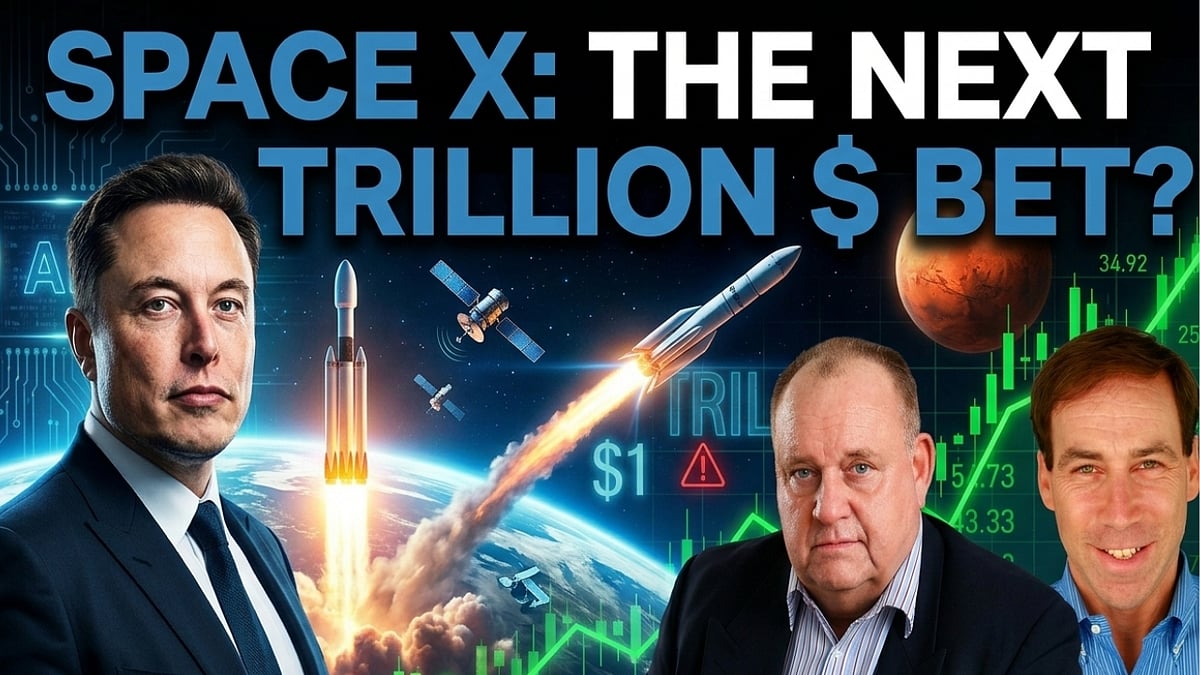
SpaceX’s blockbuster debut has reignited debate over whether Elon Musk is building the world’s most valuable company – or the next great market bubble. In this wide-ranging discussion, Magnus Heystek and Anthony Ginsberg unpack the investment case behind SpaceX, Starlink, Anthropic and OpenAI, weighing extraordinary growth potential against eye-watering valuations. From AI breakthroughs and satellite dominance to comparisons with historic manias, they explore why investors are piling in – and what could determine whether Musk’s latest venture soars or stumbles.
Sign up for your early morning brew of the BizNews Insider to keep you up to speed with the content that matters. The newsletter will land in your inbox every morning on weekdays. Register here.
Support South Africa’s bastion of independent journalism, offering balanced insights on investments, business, and the political economy, by joining BizNews Premium. Register here.
If you prefer WhatsApp for updates, sign up to the BizNews channel here.
Edited transcript of the interview
00:00:08:16 – 00:00:47:00
Alec Hogg:
Well, it’s been an extraordinary past week with the listing of SpaceX, the creation of the world’s first trillionaire, a Pretoria-based or born-and-raised Elon Musk, and lots of controversy around this one.
But someone who does own SpaceX and has been saying so on the business forums is Magnus Heystek. I’ve asked him to give me some insight, and someone who got him into SpaceX in the first place is Anthony Ginsberg, and he joins us from the United States, where I’m sure there’s all kinds of SpaceX fever.
00:00:47:02 – 00:01:03:17
Alec Hogg:
But maybe let’s start with Anthony, because Magnus was telling me off-air, Anthony, that when you were at BNC# for the business conference, where you delivered a keynote, the two of you had dinner and you said, “This was something to consider.”
00:01:04:00 – 00:01:23:10
Anthony Ginsberg:
Yes, I’ve actually been on a tour of SpaceX in the last six months. I’ve actually met the CFO of SpaceX. He’s one of the newly minted billionaires there, besides Elon – a guy called Bret Johnson, a very bright fellow who has actually survived 16 years there, believe it or not.
He told me early on, he said, “Anthony, our cash cow is Starlink.”
00:01:23:12 – 00:01:45:10
Anthony Ginsberg:
And we’d love to be in South Africa as well. That’s how I got to sort of befriend him. We have friends of friends.
And look, it’s a hell of an impressive operation there. It’s not just these payloads. They launched 165 payloads into orbit last year. They have about an 80%-plus market share, Alec.
So, just on those numbers alone, you know they’re a dominant player.
00:01:45:10 – 00:02:05:21
Anthony Ginsberg:
But actually the cash cow is Starlink, as you know, which is all to do with broadband and satellite communications, helping the Ukrainians and helping people, frankly, in rural areas around the world where the internet connection is rather weak, including, they hope, places like South Africa.
So it’s a very impressive operation. There are also arguments about the valuation.
00:02:05:23 – 00:02:24:06
Anthony Ginsberg:
There was an expectation of the IPO having a pop because index firms like myself – and we have this tech megatrend that many people have supported, and we appreciated the returns in tech land.
But there is a revolution going on broadly based here. We’ve got other things to talk about with Anthropic and OpenAI, of course, also coming down the pike quite soon.
00:02:24:06 – 00:02:49:13
Anthony Ginsberg:
So there’s a lot of excitement beyond the World Cup here in the US.
But if I could just say to you, the excitement around SpaceX goes beyond just these payloads and the orbital launches that he dominates.
He’s brought xAI in, which is the old Twitter, and it’s brought Grok in, which is his own large language model that he’s really trying to compete against the likes of ChatGPT and OpenAI.
00:02:49:14 – 00:03:10:08
Anthony Ginsberg:
So there’s a lot going on inside of this operation.
Arguably, index firms like ourselves are all buying into it because we’re basically being forced through MSCI and Nasdaq in the first 10 to 15 days of trade to actually buy the stock.
So we expected a pop, Alec, and it will probably continue to rise.
00:03:10:08 – 00:03:18:09
Anthony Ginsberg:
The question will be a year from now. Some folks believe the valuation over $2 trillion is excessive, and I’ll happily leave it at that and we can chat about it.
00:03:18:11 – 00:03:24:16
Alec Hogg:
And Magnus, how did you get to buy these shares? Because it’s only just listed.
00:03:24:18 – 00:03:52:12
Magnus Heystek:
You know, Alec, we’ve been following SpaceX and Elon Musk for a long time, and Anthony and I had dinner. I said, “Jeez, should I consider SpaceX?”
And he made a very positive comment, basically opening up my eyes. I did some research and, out of the blue, through my contacts in the investment world, I was offered a parcel of SpaceX, Anthropic and OpenAI shares.
00:03:52:14 – 00:04:18:03
Magnus Heystek:
On a confidential basis. So I can’t disclose yet where I got it from because there wasn’t an NDA included in this agreement.
I then immediately snapped up these shares and offered them to some of my clients. We’ve taken up quite a big parcel personally and for our clients.
And, you know, this will come to the market quite soon, so there’s something in the pipeline.
00:04:18:03 – 00:04:40:04
Magnus Heystek:
But to answer your question why I invested in SpaceX, I need to go back 30 years or so.
A fine young gentleman walked into my office and he said, “Listen, I’m starting this little financial services company. Don’t you want to join me? I’ve got some shares at 50 cents a share.”
00:04:40:04 – 00:05:01:05
Magnus Heystek:
And I considered it for a while, and I turned him down. I had some money in the bank at the time and I rather bought a new BMW.
Well, that gentleman was Jannie Mouton, and he started PSG.
And I did the numbers. If I’d bought PSG 30 years ago at 50 cents a share, I would have been a billionaire today.
00:05:01:05 – 00:05:29:17
Magnus Heystek:
So that burns me from time to time.
And a similar repeat came a couple of years later when someone said to me, “You should buy this Capitec. They’re into micro-lending and blah, blah, blah.”
And I looked at it at 50 cents a share, and that was Capitec.
00:05:29:19 – 00:05:52:21
Magnus Heystek:
So now I listen to all these analysts who say, “No, but you can’t value SpaceX. You need a balance sheet, and you need earnings forecasts and data.”
I’m saying I’m buying Elon Musk. I’m buying his story. I’m not going to let another opportunity pass by.
I don’t fully understand his business plan. I’ve read as much as I can.
00:05:52:23 – 00:06:29:18
Magnus Heystek:
And you’ve got guys like Jim Chanos saying it’s going to drop by 50%, and Oppenheimer & Company, which is a big company in the States, saying it’s a fantastic buy.
So there’s no consensus in the market.
But I said I am not letting this opportunity pass because, first of all, I’m backing Elon Musk. Secondly, this is a fairly unique industry, and what he’s doing – we don’t fully understand what he’s going to do.
And you have to take some risks in the world.
00:06:29:18 – 00:06:43:16
Magnus Heystek:
You know, when I think back in South Africa 120 years ago, when someone discovered gold in South Africa, in Johannesburg where we grew up, Alec, was there a business plan? Was there earnings forecasts? Was there corporate governance and all that rubbish?
No.
You take a chance sometimes in life, and this is my chance.
Now, if it works out, fantastic – my kids will fly first class. If it doesn’t work out, they’ll fly economy class.
00:06:43:18 – 00:06:46:10
Alec Hogg:
Anthony, is that a good strategy?
00:06:46:12 – 00:07:09:00
Magnus Heystek:
At the same time, I’ve got exposure to Anthropic and OpenAI, and those two are also listing later this year.
And the final point is, for a South African to get exposure to technology and technology IPOs is almost impossible. You can’t.
And here I was offered this opportunity and I grabbed it with both hands.
Am I right? Am I wrong? Life is a gamble sometimes.
00:07:09:02 – 00:07:11:05
Alec Hogg:
Anthropic and OpenAI are still coming to the market.
00:07:11:07 – 00:07:26:22
Alec Hogg:
If you were to look at the three companies, which is the one that, on the fundamentals – in other words, on what they’re doing at the moment – that you would back most strongly?
00:07:27:00 – 00:07:45:05
Anthony Ginsberg:
Well, since you’re a big follower of Warren Buffett and Charlie Munger, I have to say that Elon has built a huge economic moat.
Most people, when they look at the orbital launches, can’t compete. Jeff Bezos’ Blue Origin – I’ve actually been out to Florida to see the launch pads – is still tiny by comparison.
They had a massive failure. You probably saw the big explosion in the last two weeks.
00:07:45:05 – 00:08:10:18
Anthony Ginsberg:
Elon’s got a huge economic moat on the launches.
Interestingly enough, he’s not reliant on third-party clients as much as you might think. Something like two-thirds of those launches are Starlink-related satellites.
So it’s actually a hell of a vertically integrated business beyond what most people recognise.
There’s also, within the AI factory, let’s call it, something called Colossus, which is a massive data-centre build.
00:08:10:18 – 00:08:32:04
Anthony Ginsberg:
We’ve all been told about these huge infrastructure spends that are going on with these hyperscalers and the cloud guys spending something close to $1 trillion a year now on AI build-out.
Well, Elon’s already got his own Colossus. It’s actually out of Memphis and a few other places.
So this is a vertically integrated story.
00:08:32:06 – 00:08:54:12
Anthony Ginsberg:
And I agree with Magnus. You can’t bet against what Elon’s done.
He’s thinking way beyond just terra firma. He’s actually got these ideas to have data centres, you’ve heard, on the Moon, where he believes you can actually save a fortune on cooling mechanisms and just day-to-day energy costs.
00:08:54:14 – 00:09:17:15
Anthony Ginsberg:
And there is big discussion about him actually hitting $1 trillion of revenues.
At the moment, the revenues are tiny relative to that. So the company is in a loss-making position only because it took over Twitter, the xAI and AI businesses.
But interestingly, if he can get up to even half a trillion dollars in revenue, this will be an immensely valuable business.
00:09:17:15 – 00:09:38:21
Anthony Ginsberg:
You heard over the last 24 hours, he actually overtook Amazon to be the fifth-largest US company by market capitalisation. It’s now just fallen back to the sixth largest overnight.
But all my colleagues in the indexing world and most of the big institutions, we’re all buying into it. We can’t avoid it.
00:09:39:03 – 00:10:05:04
Anthony Ginsberg:
So look, the free float is very small. He’s only actually floated a very small percentage, under 5%, to the market.
So with all the big investment banks, from Goldman and Morgan Stanley, there’s massive pent-up demand.
We don’t see this falling back anytime soon.
A year from now, it’ll be interesting, based on the earnings, if he’s on track to get to a trillion dollars of revenue by the end of the decade.
That’s basically the plan by 2030 – to have $1 trillion of revenue.
00:10:05:04 – 00:10:25:20
Anthony Ginsberg:
So it’s very exciting times.
I think, just to answer the Anthropic question, I met one of the top three executives in Seattle last week from Microsoft.
They talked about Claude. They’ve been testing Claude.
I think it’s worth understanding that OpenAI – this is the ChatGPT guys – is a consumer-facing brand, whereas Anthropic is very much an enterprise-only brand.
00:10:25:20 – 00:10:49:12
Anthony Ginsberg:
In fact, Anthropic has got 1,000 of the largest companies in America, each spending a minimum of $1 million with them already.
And it’s very much enterprise-based.
They’re backed essentially by Nvidia and Amazon, and Microsoft have backed our friends at ChatGPT.
Anthropic is ahead of the game in terms of the IPO.
00:10:49:12 – 00:11:08:14
Anthony Ginsberg:
If they get to market first, they have an advantage because they’ll suck up quite a lot of AI dollars by beating ChatGPT to the punch.
So we’re actually very positive on Anthropic.
Just a side story about that Microsoft executive telling us that it’s so powerful and scary what Claude can do – Claude 4 and Claude 5 – that they’ve sort of quarantined it within Microsoft.
00:11:08:14 – 00:11:40:03
Anthony Ginsberg:
It was starting to have its own communication internally there with its other chatbots, that they basically had to shut this thing down.
It got so powerful they couldn’t understand what it was doing.
So Claude 5 is quite advanced.
And as you see, the Pentagon and the Trump administration have been giving Anthropic quite a hard time.
Anthropic basically works very well for highly regulated industries, from defence to financial services and healthcare.
Something like 80 of the top Fortune 100 are using Anthropic already.
00:11:40:03 – 00:11:52:06
Anthony Ginsberg:
So we’re pretty positive.
They’ve got better break-even analysis. They’re about to break even and turn positive, whereas OpenAI is still quite some way off.
00:11:52:08 – 00:12:02:01
Alec Hogg:
So Magnus, you’ve got a stake in all three of them – SpaceX, Anthropic and OpenAI.
Which is the one that makes you most excited?
00:12:02:03 – 00:12:31:07
Magnus Heystek:
Believe it or not, it’s Anthropic.
I think SpaceX is on the high side, but Anthropic is the one.
Again, there’s no media discussion in South Africa or financial analysts covering this. You’ve got to go offshore.
It is the future that you’re investing in – AI.
So Anthropic, if I have to pick one of the three, that would be my horse to come in first.
00:12:31:09 – 00:13:00:19
Alec Hogg:
I have to agree with you.
I was a huge, huge supporter of Gemini because of Demis Hassabis and his pedigree and background – Nobel Prize winner.
But my goodness, having discovered Anthropic and what they’ve got, it’s no contest.
Anthony, we had a fascinating conversation yesterday with Sy Jacobs, who said that Elon Musk has actually cracked the code of the mind.
00:13:00:21 – 00:13:30:02
Alec Hogg:
He said the market is broken when it comes to Tesla and SpaceX.
And he, if you recall, at numerous BNCs, said that his big short was Tesla.
But now he said he’s not shorting it anymore. And he sure as heck isn’t going to be shorting SpaceX because there’s a limited amount of shares available and huge demand based on – yes, it is a good company – but also there’s a heck of a lot of hype going around there.
00:13:30:02 – 00:13:37:22
Alec Hogg:
How would you read that? Because there’s some caution that comes through in what Sy had to say.
00:13:38:00 – 00:13:55:22
Anthony Ginsberg:
I agree with Sy, by the way. I wouldn’t bet against Elon.
By the way, our other friend, Roelof Botha, has just joined the board of SpaceX as well now.
So I wouldn’t bet against these two bright ex-African boys who know their oats.
00:13:55:22 – 00:14:22:06
Anthony Ginsberg:
And then you’ve also got some very bright other guys like David Sacks, who was also born in SA and who was Trump’s AI chief until very recently.
These guys, honestly, I think Magnus is in very, very good company.
You’ve got all the big boys from Goldman Sachs to CalPERS and all the large institutions all behind it.
00:14:22:09 – 00:14:44:04
Anthony Ginsberg:
I wanted to just mention: don’t count Elon out when it comes to the AI race with Anthropic either.
I know we all talk about Grok having some wobbles initially because, obviously, Grok is much more social-media orientated. It’s benefiting from the whole Twitter link.
But interestingly, Elon has just used this $80 billion from the IPO last week to go and make an acquisition in the last 36 hours.
You’ve probably heard of Anysphere.
00:14:44:04 – 00:15:04:22
Anthony Ginsberg:
Anysphere actually operates a massive AI operation called Cursor.
So there’s a lot going on that’s hard to digest.
And, yeah, these guys are thinking three-dimensional chess. Many of us are just playing one- or two-dimensional chess.
So, yeah, look, this is a long-term game.
There will be some winners and losers, clearly, but we’re in a tech revolution fundamentally.
00:15:05:00 – 00:15:29:20
Anthony Ginsberg:
Alec, I don’t want to bet against Microsoft and ChatGPT either, because that’s really a consumer-facing brand, much in the sense of a Facebook, let’s say.
So you’ve got to actually look at these operations differently.
Anthropic is an enterprise corporate Fortune 1000 operation at the moment, very close to break-even, and it’ll be more profitable than OpenAI for some time.
But Microsoft is a massive shareholder in OpenAI.
They’re not going to let this massive investment go south.
00:15:29:20 – 00:15:39:08
Anthony Ginsberg:
So we’re actually very positive. The Microsoft people I spoke with, for them, I think they’re more bullish, frankly, on ChatGPT for the moment.
00:15:39:10 – 00:16:05:09
Alec Hogg:
Okay. And so the one thing that Sy did say was that he expects, despite the fact that, if you put it politely, Elon Musk is gaming the market, despite that, he said he feels that SpaceX’s share price is not going to fall anytime soon.
That said, Jeanette – my wife, who’s not an avid investor, but she’s very keen to buy some SpaceX shares – and I’ve said, be a bit cautious.
I want to get the view from the two of you, as financial advisors.
Maybe starting with you, Magnus. I know you’re a shareholder, so clearly you’re on this SpaceX bandwagon, but should Jeanette put her hard-earned cash in there?
00:16:26:01 – 00:16:43:17
Magnus Heystek:
I would probably recommend that she puts her money into an index-based fund like the one Anthony is running, the Hanseatic MegaTech Fund, which we’ve been using for our clients for a long time.
And more so because I’ve held personally, and I’ve actually written an article on this, which hopefully I can finish this week.
00:16:43:19 – 00:17:10:14
Magnus Heystek:
And what I’m saying to you is that most South African investors, whether in unit trusts or share portfolios or pension funds, have missed out on the technology boom over the last 15 years for various reasons.
We don’t have time to go through it, but the South African investment industry has actually just missed the boat.
They’re not involved. They’ve not been recommending it, and they’ve been buying a bit of Naspers, and that’s cost them dearly.
00:17:10:17 – 00:17:30:07
Magnus Heystek:
If I look at some of my clients, or our clients, who took money off 14 or 15 years ago and put it into technology, they’re extremely wealthy today.
And again, whenever I try to raise this issue at investment seminars and ask the local fund managers, “What about technology?”
They say, “No, it’s too risky, it’s too far away. Don’t bother. Just keep on investing in the local market.”
00:17:30:07 – 00:17:58:12
Magnus Heystek:
And the returns over 10, 15 years have been astronomical.
So we’ve always had a good exposure to technology funds.
But the best way would be to put it through an index-based fund like Anthony’s. Let the index decide.
Don’t make personal calls on companies – you’re going to get it wrong – and the index will adjust in terms of weightings, et cetera, et cetera.
00:17:58:14 – 00:18:08:22
Magnus Heystek:
And that fund is doing extremely well for our clients.
I’m punting Anthony’s fund, but it’s actually the way to go for the average investor in South Africa wanting exposure to these exciting industries.
00:18:09:00 – 00:18:11:01
Alec Hogg:
But she wants SpaceX.
00:18:11:03 – 00:18:15:04
Magnus Heystek:
She doesn’t want an index.
00:18:15:06 – 00:18:22:14
Magnus Heystek:
Then she gives me a call, and I’ll help her.
00:18:22:16 – 00:18:40:16
Anthony Ginsberg:
For folks like Jeanette and others, for their spare cash and some play money, I would say yes, you could play the stock market with some of that spare change.
But I think what Magnus is saying is, for your key building blocks, you don’t have to be all-in on these “Magnificent Seven”, for example.
The Tech Megatrend Index is actually up about 50% almost year-to-date.
00:18:40:16 – 00:19:01:17
Anthony Ginsberg:
Now, it’s actually equity-weighted across about 10 sub-themes within tech.
And South Africans don’t typically hear about these.
These are cybersecurity companies, the likes of Palo Alto Networks.
Then you’ve got gene-editing plays, AI, social-media plays.
It’s all tech convergence across cloud computing and digital entertainment, like Netflix, also using AI now.
00:19:01:17 – 00:19:22:10
Anthony Ginsberg:
We’ve seen mergers between the cloud guys and the cybersecurity boys.
You’re seeing Elon and others in the AI space buying into some robotics players as well.
So even the onshoring from the Trump administration is actually boosting global players.
I would say it’s not just an American story.
I’ll make the tech megatrend really interesting: it’s only about 60% American-based.
00:19:22:14 – 00:19:34:04
Anthony Ginsberg:
The Japanese and South Koreans, for years, have been leaders in robotics, for example.
We’ve done very well there.
Then you’ve got Taiwan Semiconductor, you’ve got lots of other players, ASML, the big Dutch company that you know.
00:19:34:06 – 00:19:36:00
Alec Hogg:
She still…
00:19:36:02 – 00:19:41:19
Alec Hogg:
Anthony, she wants SpaceX. And I want an answer to SpaceX as well. Can I tell you?
00:19:41:21 – 00:20:00:12
Anthony Ginsberg:
Yes, I would say you can dollar-cost average into SpaceX.
My own view is that with the index firms all buying in over the next 10 to 15 days – these are guys like Nasdaq, MSCI, ourselves – we actually see it being a reasonably healthy price at the moment.
00:20:00:12 – 00:20:12:13
Anthony Ginsberg:
It’s all going to come down to the earnings per share, the earnings numbers over the next 6 to 12 months.
There may be a pullback six months from now. We wouldn’t be that surprised.
So I would say, bleed it in over time. Don’t do it all on one day.
00:20:12:15 – 00:20:37:18
Alec Hogg:
Very smart advice.
It is a phenomenon. It is something that’s terribly exciting amongst many people.
I had somebody tell me the other day that they’ve made more money out of buying SpaceX early on than they’ve made out of anything else.
So it’s been a phenomenal investment for those people who followed Elon Musk in the way that Magnus should have followed Jannie Mouton.
00:20:37:20 – 00:21:09:10
Alec Hogg:
But when we look ahead to the next maybe 6 to 12 months on SpaceX in particular, given that – I’m not sure if you were aware – but Sy told me yesterday there was R100 million that was invested in SpaceX by equities clients.
So lots of retail investors are in it.
What should they be looking for in the next 6 to 12 months from this company, given that the earnings are of a kind of irrelevant?
00:21:09:12 – 00:21:31:17
Alec Hogg:
Again, I was saying you use the comparison of Microsoft, which is roughly the same as SpaceX.
Microsoft turns over $380 billion, SpaceX turns over $19 billion, and the one makes a lot of money and the other one loses a lot of money.
So it really isn’t the game here.
You’ve got to believe in something much bigger.
00:21:31:17 – 00:21:43:15
Alec Hogg:
But what can the company tell them that they should either be more confident in their view or a little cautious in the next 6 to 12 months?
Anthony.
00:21:43:17 – 00:22:06:18
Anthony Ginsberg:
The two things I’m looking at are actually the growth of Starlink.
Is the satellite operator actually growing beyond double digits?
Is it actually growing at a clip of about 25% to 30% year-on-year?
That’s what we’re seeing actually in the tech space.
Interestingly, not all tech valuations are excessive.
00:22:06:18 – 00:22:35:08
Anthony Ginsberg:
The average PE ratio currently in the US on tech in our index is around 22 times earnings.
That’s not excessive.
The Magnificent Seven may be significantly overpriced.
When it comes to SpaceX, I would say you can’t do a PE analysis right now.
So look at the earnings, particularly within the underlying businesses.
00:22:35:10 – 00:22:53:07
Anthony Ginsberg:
You’ve got this new acquisition they just took over.
Look at what’s going on with xAI. This is the Grok operation.
Twitter lost about 50% of its advertising base when it was first acquired by Musk.
He’s rebuilding that.
So let’s see how mainstream Twitter can be.
00:22:53:07 – 00:23:11:16
Anthony Ginsberg:
They can take some stick.
I’m looking at that as well.
And then I’m also looking at their launches – the number of launches.
Can they actually increase the launch frequency from about 165 a year to maybe 200 a year?
00:23:11:16 – 00:23:40:06
Anthony Ginsberg:
This is with the Falcon 9 rocket that I actually saw personally.
It’s a crazy-looking huge rocket.
And they’ve got a new rocket that’s actually going to supersede that.
They’ve got some very big defence contracting agreements with the Pentagon and with NASA.
So that’s all coming down the pike, I think, in the next 6 to 12 months that I’d be looking at.
00:23:40:08 – 00:24:04:14
Alec Hogg:
Magnus, the other thing that Sy said was that with this very highly rated script that Elon now has, he can do a lot of acquisitions.
And the one that Anthony referred to – an $8 billion all-share acquisition of a startup, essentially, but a very powerful AI software producer – is that the kind of thing that you’re looking for, to see whether he’s spending that equity cash, as it were, wisely?
00:18:09:00 – 00:18:11:01
Alec Hogg
But she wants SpaceX.
00:18:11:03 – 00:18:15:04
Magnus Heystek
She doesn’t want an index.
00:18:15:06 – 00:18:22:14
Magnus Heystek
Then she gives me a call.
00:18:22:16 – 00:18:40:16
Anthony Ginsberg
For folks like Janet and others, for their spare cash and some play money, I would say yes, you could play the stock market with some of that spare change. But I think what Magnus is saying is, for your key building blocks, you don’t have to be all-in on these Magnificent Seven, for example.
The Tech Megatrend Index is actually up about 50% almost year-to-date now. It’s actually equity-weighted across about, let’s say, ten sub-themes within tech.
00:18:40:16 – 00:19:01:17
Anthony Ginsberg
And South Africans don’t typically hear about these. These are cybersecurity companies, the likes of Palo Alto Networks. Then you’ve got gene-editing plays, you’ve got AI, you’ve got social media plays.
It’s all tech convergence across cloud computing, digital entertainment like Netflix, also using AI now.
00:19:01:17 – 00:19:22:10
Anthony Ginsberg
We’ve seen mergers between the cloud guys and the cybersecurity boys. You’re seeing Elon and others in the AI space buying into some robotics players as well.
So even the onshoring from the Trump administration is actually boosting global players. I would say it’s not just an American story.
Actually, I’ll take the Megatrend Index — it’s only about 60% American-based. The Japanese and the South Koreans for years have been leaders in robotics, for example.
00:19:22:14 – 00:19:34:04
Anthony Ginsberg
We’ve done very well there. Then you’ve got Taiwan Semiconductor, you’ve got lots of other players, ASML, the big Dutch company that you know.
00:19:34:06 – 00:19:36:00
Alec Hogg
She still—
00:19:36:02 – 00:19:41:19
Alec Hogg
Anthony, she wants SpaceX. And I want an answer to SpaceX as well. Can I tell?
00:19:41:21 – 00:20:00:12
Anthony Ginsberg
Yes, I would say you can dollar-cost average into SpaceX. My own view is that with the index firms all buying in over the next 10 to 15 days — these are guys like Nasdaq, MSCI, ourselves — we actually see it being a reasonably healthy price at the moment.
It’s all going to come down to the earnings per share, the earnings numbers over the next 6 to 12 months.
00:20:00:12 – 00:20:12:13
Anthony Ginsberg
There may be a pullback six months from now; we wouldn’t be that surprised. So I would say, bleed it in over time. Don’t do it all on one day.
00:20:12:15 – 00:20:37:18
Alec Hogg
Very smart advice. It is a phenomenon. It is something that’s terribly exciting amongst many people.
I had somebody tell me the other day that they’ve made more money out of buying SpaceX early on than they’ve made out of anything else. So it’s been a phenomenal investment for those people who followed Elon Musk in the way that Magnus should have followed Jannie Mouton.
00:20:37:20 – 00:21:09:10
Alec Hogg
But when we look ahead to the next maybe 6 to 12 months on SpaceX in particular, given that — I’m not sure if you were aware — but Sy told me yesterday there was R100 million that was invested in SpaceX by equity clients.
So lots of retail investors are in it. What should they be looking for in the next 6 to 12 months from this company, given that the earnings are of a kind of irrelevant?
00:21:09:12 – 00:21:31:17
Alec Hogg
Again, I was saying you use the comparison of Microsoft, which is roughly the same as SpaceX. Microsoft turns over $380 billion, SpaceX turns over $19 billion, and the one makes a lot of money and the other one loses a lot of money.
So really, that isn’t the game here. You have to believe in something much bigger.
00:21:31:17 – 00:21:43:15
Alec Hogg
But what can the company tell them that they should either be more confident in their view or a little cautious in the next 6 to 12 months? Anthony.
00:21:43:17 – 00:22:06:18
Anthony Ginsberg
The two things I’m looking at are actually the growth of Starlink. Is the satellite operator actually growing beyond double digits? Is it actually growing at a clip of about 25% to 30% year-on-year?
That’s what we’re seeing, actually, in the tech space.
Interestingly, not all tech valuations are excessive. The average PE ratio currently in the US on tech in our index is around 22 times earnings. That’s not excessive.
00:22:06:18 – 00:22:35:08
Anthony Ginsberg
The Magnificent Seven may be significantly overpriced. When it comes to SpaceX, I would say you can’t do a PE analysis right now.
So look at the earnings, particularly if you can within the underlying businesses. You’ve got this new acquisition they just took over. Look what’s going on with XAI. This is the Grok operation.
Twitter lost about 50% of its advertising base when it was first acquired by Musk. He’s rebuilding that.
00:22:35:10 – 00:22:53:07
Anthony Ginsberg
So this is seeing how mainstream Twitter can be. They can take some stick.
I’m looking at that as well. And then I’m also looking at their launches – the number of launches. Can they actually increase the launch frequency from about 165 a year to maybe 200 a year?
00:22:53:07 – 00:23:11:16
Anthony Ginsberg
So that’s going to be this – with the Falcon 9 rocket that I actually saw personally. It’s a crazy-looking huge rocket.
And they’ve got a new rocket that’s actually going to supersede that. And they’ve got some very big defence contracting agreements with the Pentagon and with NASA.
So that’s all coming down the pike, I think, in the next 6 to 12 months that I’d be looking at.
00:23:11:18 – 00:23:40:06
Alec Hogg
Magnus, the other thing that Sy said was that with this very highly rated script that Elon now has, that he can do a lot of acquisitions.
And the one that Anthony referred to — the $60 billion all-share acquisition of a startup, essentially, but a very powerful AI software producer — is that the kind of thing that you’re looking for to see where he spins that equity cash, as it were, wisely?
00:23:40:08 – 00:24:04:14
Magnus Heystek
I think essentially I come back to my answer earlier. Are you backing the man? And you’re backing his track record.
And you’re backing guys like Rolof Botha. I didn’t know that he is a director — super. This is an extremely, extremely smart guy who was running Sequoia, still is running Sequoia.
We’re talking about very smart people. We’re talking about Australia’s richest woman who put in $100 million into SpaceX.
00:24:04:14 – 00:24:25:10
Magnus Heystek
This is a once-in-a-lifetime opportunity. It’s not going to come around again.
And that’s the kind of approach to take for the smaller investor. I would say don’t try and time the market. Don’t try and listen to gossip and snippets of information.
Buy the big picture. You go in, buy it, and say, “I’m going to open this envelope five years from now.”
00:24:25:12 – 00:24:46:07
Magnus Heystek
That’s my approach to my personal investment. I tell my wife she bought some, my kids bought some. I said, “Guys, I’m not going to talk to you for five years and then we can talk.”
But obviously, I will look at it every day. But that’s the approach. That’s the approach.
00:24:46:07 – 00:24:58:15
Magnus Heystek
We do not understand what — you know, my biggest risk, and I think it’s an obvious risk, is that Musk doesn’t wake up one morning and boom, that whole thing comes apart.
That’s the biggest risk: the mortality risk of Elon Musk.
00:24:58:16 – 00:25:22:15
Alec Hogg
I’m going to leave you with one last thought.
Hundreds of years ago, there was a thing called the South Sea Bubble. And people like today got terribly excited about something that was unknown, something that was foreign, something that was exciting, something that was promising riches beyond wildest dreams.
00:25:22:15 – 00:25:47:13
Alec Hogg
And the South Sea Bubble inflated to a point where it exploded. And everybody who put money in lost, including Scotland pretty much lost its treasury.
The Elon Musk story, the SpaceX story — is it not another South Sea Bubble?
It’s into space. It’s onto Mars. It’s going to be populating Mars with human beings. It’s something so wild and so far that most of us are baffled to get our heads around it.
00:25:47:14 – 00:25:52:12
Alec Hogg
Is this not something that we should be at least thinking about?
00:25:52:14 – 00:26:16:01
Magnus Heystek
The smartest guy in the world at that time, Newton, put a lot of money — he wiped out his family money in the South Sea Bubble.
So there’s always a risk. If we invest in this type of industry, if you’re looking for predictability and guarantees and assurances, this is not the right place.
00:26:16:03 – 00:26:44:21
Magnus Heystek
This is the Wild West at the moment. I don’t fully comprehend it. I’ve been reading, reading, reading — what his ideas are: colonising Mars with a million people, mining asteroids.
I mean, it sounds like Hollywood taking steroids with its stories. That’s coming up.
But my golly, this guy is doing something. Starlink — I mean, nothing says cash cow like low-orbit satellites connecting people.
00:26:44:21 – 00:27:05:03
Magnus Heystek
And all the other projects, which maybe we’re just not seeing or fully understanding. But there are some smart guys.
I mean, a guy like Rolof Botha would not have joined the board of SpaceX if he didn’t look at these numbers.
Remember, he’s one of the smartest guys from South Africa, a top actuarial student. And he went to Silicon Valley 20 years ago.
00:27:05:04 – 00:27:14:03
Magnus Heystek
I mean, those are very, very smart people. I’m backing him. I’m not going to make the ultimate mistake.
00:27:14:05 – 00:27:15:18
Alec Hogg
Anthony. Last word.
00:27:15:20 – 00:27:31:06
Anthony Ginsberg
One last word from here is, as Magnus says, it’s time in the market, not trying to time the market.
And the other quick thing on the States is those with a bit of grey hair — when we started our careers in the late ’90s or early 2000s — we all thought the internet would be the best thing since sliced bread.
00:27:31:07 – 00:28:06:04
Anthony Ginsberg
Ultimately, Amazon and others have proven successful, but those businesses that went under in the bubble in 2000, 2001, they were not built on the subscription revenues that AI and cloud and even what Elon is doing have.
These old guys have got basically much stronger cash-flow-generated stories.
Starlink and others, most of the cloud companies, cybersecurity companies — they’re all built on a monthly subscription revenue and have much more flexible ways of actually adapting to the demand and turning up and down the dial.
00:28:06:06 – 00:28:22:16
Anthony Ginsberg
Those old internet businesses — WebMD, Pets.com — never had it. They were blowing money on every cup and Super Bowl adverts.
It’s a very different picture today. I think it’s a much more advanced financial story. So we’re much more positive than what happened back 25 years ago.
00:28:22:18 – 00:28:24:03
Alec Hogg
Very, very good.
00:28:24:05 – 00:28:46:08
Magnus Heystek
Just one last point on this.
I remember about 30 years or 25 years ago, I wanted to play golf with three gentlemen from Finland. They were executives of Nokia. They were coming to South Africa because they wanted to start selling cell phones to the South African population.
And I played golf with them.
00:28:46:10 – 00:29:09:23
Magnus Heystek
And after the round of golf, I asked these guys, “Guys, tell us about your business. How many cell phones do you think you’ll sell into the South African market?”
And they came back and said, “Our research indicates maybe 100,000 cell phones.”
What is the market in South Africa?
The point I’m trying to make is there are not 100 million cell phones that are in use in South Africa today.
00:29:10:04 – 00:29:38:00
Magnus Heystek
There is an application of a technology which we did not fully understand how widespread it is today.
Now, again, this is an example. The future is so unpredictable in terms of technology. And the stuff that Elon Musk is predicting now could be commonplace 20 years from now.
And everybody’s using it — AI and satellites and mining asteroids as they come along — and we say, “Oh, everybody’s doing it.”
00:29:38:00 – 00:29:46:04
Magnus Heystek
And so I’m just saying, I’m in, and we’ll see how it goes.
00:29:46:06 – 00:30:08:21
Alec Hogg
Magnus, thank you for that reminder. And thank you as well, Anthony.
We are a subscriber to Starlink through our colleague in Malawi. And I’ll tell you what the big advantage they’ve got is: A, they get the cash every month, and B, if you don’t pay, they cut you off.
So it’s a fantastic business model and presumably one that is generating good margins for them as well.
00:30:08:21 – 00:30:32:21
Alec Hogg
And it certainly keeps a colleague in Malawi better in touch than he could be if he were in a city in South Africa. Ironic, but it’s true.
It’s good to have got the other side of the Starlink picture from two of the fans. And I think that, well, there are many other fans in the business community, that’s for sure.
00:30:32:22 – 00:30:44:17
Alec Hogg
Magnus Heystek, Anthony Ginsberg. I’m Alec Hogg from BizNews.com.
Leave a Reply