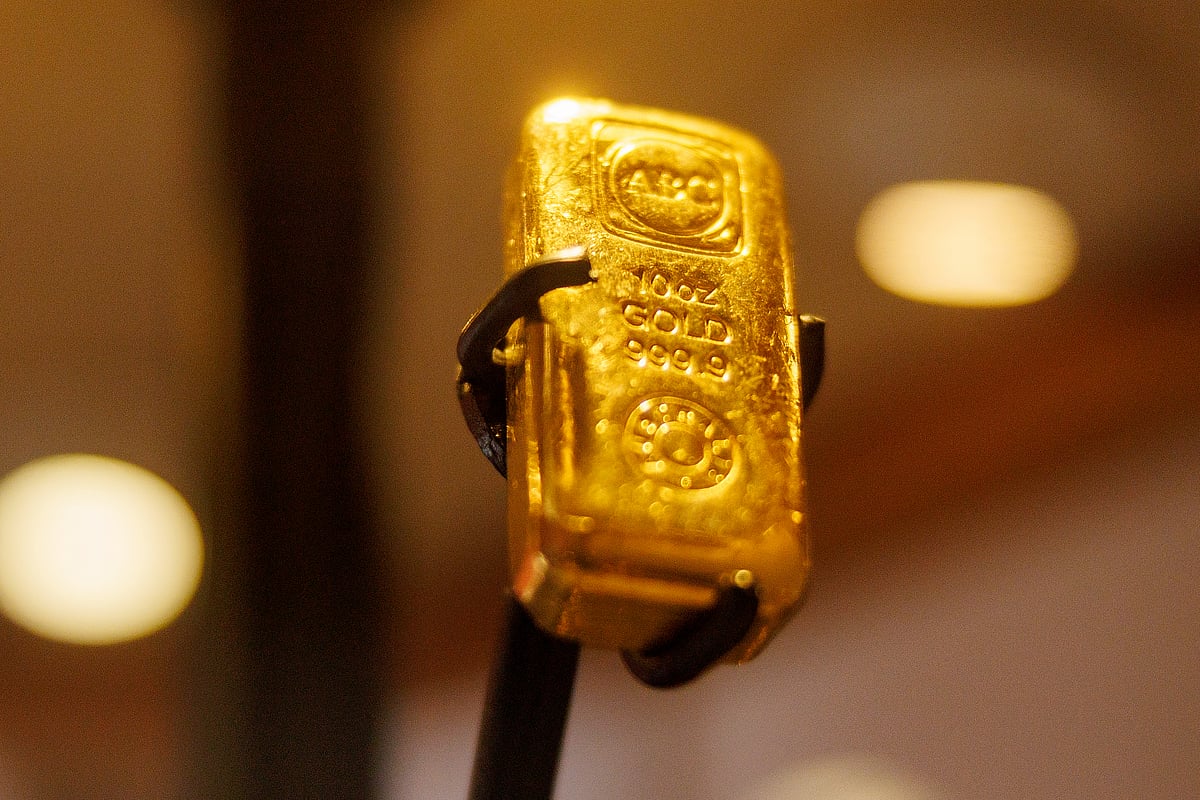
Global gold discovery has stalled: no major find anywhere in 2023 or 2024, the first time on record, while producers’ reserves shrink and the pipeline empties. In this Gold Papers instalment, Dr Duarte da Silva argues the world’s response has overlooked the obvious candidate — South Africa’s abandoned Witwatersrand residual, estimated at 48,100 tonnes, comparable in scale to the world’s entire proven reserve book. Da Silva is careful to separate resource from reserve, but his point stands: in a gold market starved of new supply, South Africa’s already-discovered, already-drilled endowment is the cheapest and largest swing asset left on the planet.
By Dr Duarte de Silva
Key numbers
-
0 · 0 — Tier-1 (≥2 Moz) gold discoveries in 2023 and 2024 — the first time on record
-
7.7 → 4.4 Moz — average size of a new gold discovery: prior decade vs the 2020s
-
~60,000 t vs 48,100 t — the world’s entire proven reserve book vs the residual South Africa abandoned
The demand case is by now well rehearsed: gold re-monetised in 2022 and its price has structurally re-rated. This paper makes the other half of the same argument — the supply side — and it is the half a London generalist cares about most, because it decides where the next decade of gold actually comes from. The answer the global supply map gives is alarming: it is coming from almost nowhere. No major discovery in two straight years, a pipeline emptying faster than it fills, and the easy ground long gone. Set that scarcity beside one number and the entire frame on South Africa inverts. The country so often written off as a problem is, on the world supply map, the single largest answer to it.
The strategic case · one endowment, read from the world’s supply map
-
Monetary value
-
Global scarcity
-
Strategic breadth → a national strategic asset
The other half of the story
I. Where does the next decade of gold come from?
There is a question the gold price has been asking for three years that the gold industry cannot answer. The demand side is well established: central banks re-monetising the metal, the dollar fracturing, a structural bid under the price that is not going away. Demand has a clear story. Supply does not. At a record price, with every incentive in the world to find and build new mines, the industry that produces gold is quietly failing to replace what it digs. The bull case for gold is usually told entirely from the demand side. The supply side is, if anything, the stronger half — and almost no one tells it.
This paper tells it, and then asks the only question that follows from it: if the world is running short of new gold, where does the next decade’s supply actually come from? Not in theory — on the map. When you lay the global supply picture out honestly, the answer is uncomfortable for everyone except the one country so often cast as the problem. The largest single known source of incremental gold on earth is not a discovery waiting to be made in a frontier jurisdiction. It is a basin everyone has already agreed to call finished.
The bull case for gold is told from the demand side. The supply side is the stronger half — and it ends, improbably, in the one basin the world has written off.
II. The gold is not being found — Exhibit A: The Discovery Drought
Start with the fact that should stop a supply analyst cold. In 2023, and again in 2024, not a single tier-one gold discovery — a deposit of two million ounces or more — was made anywhere on the planet. According to S&P Global, it is the first time in the modern record that two consecutive years have produced no major discovery at all. The deposits that crossed the two-million-ounce threshold in 2024 were not new finds; they were old discoveries, drilled decades ago, reclassified upward. The geology desk found nothing. The accounting desk did the work.

Behind that headline the trend is years deep. The average size of a new gold discovery has fallen from about 7.7 million ounces in the prior decade to 4.4 million in the 2020s. Across the whole of 2020 to 2024, the industry made just six discoveries worth counting, totalling around 27 million ounces of reserves and resources combined — roughly three months of world production, found in five years. And the era of the supergiant is simply over: in the 1970s, 1980s and 1990s the world found at least one fifty-million-ounce deposit per decade; since 2000 it has found none. This is not happening because exploration stopped. It is happening despite a record price and despite the easy comfort that high prices cure everything. The grassroots ground has been walked. The big, shallow, obvious deposits have been found. What is left to discover is smaller, deeper and rarer every year.
And it is not for want of trying, which removes the obvious objection. This is not a drought caused by a lack of money: it has happened straight through a period of record and rising gold prices, exactly when the incentive to explore is at its strongest. Where the exploration dollars have gone, they have increasingly gone into drilling out and extending known deposits rather than into the grassroots search that finds new ones, because the market rewards the safer ounce. The industry is spending to confirm what it already has while genuinely new discovery — the thing the next supply cycle depends on — quietly stops happening. High prices were supposed to cure scarcity. On the discovery data, they have not.
Put a number on the trying, because the number is the argument. The world now spends on the order of five and a half billion dollars a year hunting for gold, on S&P Global’s count, and several billion in every year of this decade. Reckon it up across 2020 to 2024 and the industry sank well over twenty billion dollars into the search. What it bought, in genuinely new major deposits, was six finds and roughly 27 million ounces — not one of them in the last two years. Worse, the slice of that budget aimed at the grassroots hunt that actually turns up new ground has collapsed to about nineteen per cent, a record low and half of what it was a generation ago; the money that stays in the game goes into drilling the fences of mines that already exist. So this is not a search called off for lack of funds. Tens of billions went looking. The ground gave up barely three months of supply. When that much capital hunts that hard, at a record price, and comes home with that little, the lesson is not that the industry stopped trying. It is that the easy gold is gone.
III. The majors are mining faster than they replace — Exhibit B: The Pipeline Is Emptying
If discovery is the front of the pipeline, the producers’ reserve books are the back of it, and they are draining. McKinsey’s work on the sector put it starkly: across a recent five-year span the gold reserves of the largest producers fell by about 26 per cent — from roughly 967 to 713 million ounces — while the average life-of-mine compressed from around 19 years to 16.5. The companies were barely able to replace the ounces they were digging, even by converting nearby resources to reserves. A mining company that cannot replace what it produces is, in the blunt phrase the industry uses about itself, on course to deplete itself out of business.
Watch how the majors have responded, because their behaviour gives the diagnosis away. They have not out-explored the problem; they have bought their way around it. The reserve recovery the sector has shown since — back toward roughly 745 million ounces by 2024 — was bought, not found: Newmont absorbing Newcrest, the Barrick-Randgold combination, ounce-buying at scale by companies that could no longer find ounces themselves. M&A reshuffles existing reserves between owners; it does not add a single new ounce to the world’s total. And alongside the buying sits the now-familiar behaviour: a sector that paused dividends but protected buybacks, returning capital to shareholders rather than spending it on the drilling that finds the next mine. A buyback flatters the share count. It does not extend a single mine’s life. Wood Mackenzie has estimated that something like 44 separate projects would need to succeed simply to hold global output flat. The pipeline is not full enough to do it.
And time is the cruellest line in the arithmetic. The lag between discovering a gold deposit and pouring the first bar has stretched to something like fifteen to seventeen years — permitting, financing, construction, ramp-up. That means the supply of the next decade is, in effect, already fixed: it will come from deposits found in the 2000s and 2010s, because anything found now is a mine for the 2040s. Even in the impossible best case, with discovery roaring back to life tomorrow, there is no new metal from it for the better part of two decades. The coming shortfall is not a forecast that might still be avoided. On the timelines the industry actually runs on, the next ten years of scarcity are already baked in.
IV. The honest version of the cliff — Exhibit C: Peak or Plateau
Here the argument has to be careful, because the catastrophe version is where credibility goes to die — and the case does not need it. Two serious houses read the same data differently, and an honest paper states both. CRU takes the harder line: it sees mine output peaking around 2025 and then entering a prolonged decline as reserves deplete, grades fall and ageing mines close — a cliff, in its analyst’s word, after 2025. The World Gold Council is more moderate: it sees output not falling off a cliff but gradually plateauing over the next several years near current record levels, with new projects and ramp-ups providing support even as declining reserves and rising capital costs cap the upside. Mined production in 2024 was about 3,645 tonnes — the second-highest annual total ever. So this is not a story of supply collapsing tomorrow. It is a story of supply running flat-out, at a record, with nothing visible behind it.
Notice that the two forecasts agree on everything that matters for this paper. Whether the line peaks and falls or peaks and plateaus, the marginal new tonne of gold gets harder, deeper, lower-grade and more expensive everywhere on earth, every year from here. Both houses agree the discovery pipeline cannot support material growth; both agree grade is declining and capital intensity rising; both agree the easy gold is gone. The disagreement is about the slope of the top of the mountain, not about the fact that the climb is over. You do not need the cliff. The plateau is enough. A world whose gold supply is, at best, flat at a record while demand structurally re-rates is a world with exactly one question worth asking: where is the cheapest incremental tonne?
And remember what this flat supply is colliding with. The demand side of the same vice is stark: central banks taking more than a thousand tonnes of gold a year out of the market in each of 2022, 2023 and 2024 — a structural, largely price-insensitive bid that did not exist a decade ago. Put a buyer that wants over a thousand new tonnes a year against a mine supply that is, at best, flat near 3,600 tonnes, and the arithmetic closes only one of two ways: through price, or through new supply. There is one pressure valve, recycling — old jewellery and scrap melted back when the price is high — but recycling is gold already above ground changing hands, not one new tonne added to the world’s stock, and it has never filled a structural gap. Flat-to-falling mine supply, a permanent official bid, and no relief valve that adds new metal: that is the engine under the gold price, and it is why the question of where the next mined tonne comes from is not academic.
V. The ground South Africa wrote off is the size of the world’s reserve book — Exhibit D: The Juxtaposition
Now the single comparison this whole paper is built to deliver, and it has to be made with scrupulous honesty or it is worth nothing. The United States Geological Survey puts the world’s identified, economically extractable gold reserves — every country, every mine, the entire planet’s booked reserve — at somewhere around 57,000 to 64,000 tonnes. South Africa’s residual Witwatersrand endowment, on peer-reviewed estimate, is about 48,100 tonnes. The ground South Africa has agreed to call finished is comparable in scale to the entire world’s remaining reserve book.

State the caveat loudly, because the comparison is honest only if it is explicit. These two numbers are not the same kind of number. The world’s ~60,000 tonnes is reserve — gold proven economic to mine under current conditions. South Africa’s 48,100 tonnes is endowment — a resource, gold known to be in the ground but not booked as reserve; on the USGS’s own conservative reserve line, South Africa’s booked figure is only about 5,000 tonnes. So this is not a claim that South Africa has as much mineable gold today as the rest of the world combined. It is a claim about the candidate pool. The world’s reserve base is what has already been converted from resource to reserve; the world’s problem, set out in the exhibits above, is that the resource feeding new reserves has stopped being discovered. South Africa is sitting on the largest single block of already-discovered, already-drilled gold resource on earth — the very thing the rest of the world is failing to find — and has simply declined to convert it. The reserve-versus-resource gap is not a weakness in the argument. It is the argument: the conversion is the opportunity.
VI. The fair comparison — endowment against endowment — Exhibit E: Like for Like
A fair critic will not let the last exhibit stand as it is, and is right not to. Reserve against endowment is not a like-for-like measure — one number has been proven economic to mine, the other has only been found — and no amount of careful labelling fully repairs a comparison between two different kinds of thing. So set that comparison aside. Strip the world’s reserve book out of it altogether. Measure the Witwatersrand the one way that removes the objection at the root: endowment against endowment — the total gold each great province of the earth is known to contain, already mined plus still in the ground, counted the same way everywhere. Now the categories match. Now there is nothing left to quibble over. The only question left is what the like-for-like number actually says.
It says the Witwatersrand is not in the same size class as anything else on the planet.

Total gold endowment — cumulative past production plus remaining reserves and resources, contained metal — for the foremost gold provinces on earth, counted on one basis throughout. Figures are order-of-magnitude, drawn from the USGS, S&P Global, company filings and the district literature; province boundaries follow conventional usage. The Witwatersrand line spans published produced-plus-remaining estimates; the ~48,100 t residual discussed above is the unmined portion of it.
Read down that column and the scale stops being a figure of speech. The Carlin trend built the modern American gold industry; Muruntau is the largest open pit ever cut for the metal; Grasberg is the richest gold-copper system on the planet. These are the giants of the supply map — and set end to end, the next five great gold provinces on earth do not come to what South Africa has already pulled out of one basin, never mind what it left behind. The residual alone — the gold the country walked away from, about 48,100 tonnes, roughly 1.55 billion ounces — outweighs every other province on this table combined. Not their reserves. Their entire endowments, mined and unmined together. That is the comparison with the category problem stripped out of it. It does not soften the claim. It hardens it.
And here the reflex about endowment figures runs exactly backwards. The standard objection is that endowment is the softest number in mining — a hopeful extrapolation from a handful of drill holes, the kind of figure that evaporates the day someone finally sinks a shaft. Fair enough, for a frontier: the number a promoter quotes for an untested belt no one has ever mined is a model, and models disappoint. But the Witwatersrand endowment is the opposite kind of number. It is the most ground-truthed gold figure on earth. It does not rest on a guess about what might lie below; it rests on 140 years of taking the metal out — on some 1.6 billion ounces already hauled to surface, on reef horizons followed for more than 150 kilometres of strike, on thousands of deep boreholes and a century of stope-by-stope grade control, on a basin whose very origin was settled in the journals only after it had been mined clean through. We are not guessing at the Witwatersrand. We have read it from the inside. The gold that remains sits between and beneath workings whose grades are already logged, in reefs whose position is already drawn. Of every endowment number in world gold, this is the one least likely to be a fantasy — because it is the one the world has already spent a century proving by extraction.
That is why the like-for-like test matters more than the headline juxtaposition, not less. A sceptic can argue all day about whether South Africa’s residual belongs beside the world’s reserve book or its resource base. No one can argue that the Witwatersrand is anything other than the largest single endowment of gold the planet holds — on any measure, read the same way for everyone. The rest of the world is straining and failing to find new provinces a tenth this size. South Africa is sitting on the one it already found, already drilled, already proved by the act of mining it — and elected to stop counting.
The state of gold supply
VII. The supply map on one page

Sources: S&P Global Market Intelligence (discoveries); McKinsey (reserve and life-of-mine decline); CRU and the World Gold Council (output outlook); Wood Mackenzie (projects required); USGS Mineral Commodity Summaries 2025 (world reserves); peer-reviewed Witwatersrand endowment estimate. Reserve and resource are different categories and are labelled as such.
VIII. Why the swing asset is the one already found — Exhibit F: The Cheapest Incremental Tonne
Put the supply scarcity and the South African block together and the investment logic reframes completely. In a peak-supply world, the binding question is not “where is there gold?” but “where is the cheapest next tonne of it?” And once you ask it that way, the frontier discovery — the thing the whole industry is straining and failing to produce — turns out to be the most expensive answer, not the cheapest.
Compare the two candidates honestly. The frontier route is a new discovery: on current averages, about 4.4 million ounces, in a remote or politically fragile jurisdiction, found after a decade of grassroots spend, then permitted, financed and built over the fifteen-to-twenty-year lag that now separates discovery from first pour. It is small, slow, deep, far away, and exposed to every sovereign risk on the map. The South African route is the opposite on every axis. The gold is already found — drilled, mapped, quantified over 140 years. A significant portion of it is on surface, in the tailings, or at shallow depth, requiring no exploration and, in the surface case, no shaft. It sits in a basin with a century of roads, power, rail, water and metallurgical skill already in place. And it is enormous — orders of magnitude larger than any discovery the world is capable of making. The cheapest incremental tonne of gold on earth is not a tonne someone still has to find. It is a tonne South Africa found generations ago and chose to abandon.
This is the reframe seen from the supply desk rather than the Pretoria ministry. The machinery to act on it — the licence, the reclassification of a known resource at a price that now plainly exists — is a policy problem, and a solvable one. What this paper supplies is the reason that machinery matters to someone who has never heard of the Witwatersrand: because in a world that cannot find gold, the largest pool of already-found gold is the single most valuable swing asset on the supply map. South Africa is not the swing asset despite having abandoned its gold. It is the swing asset because the gold is already found, and abandonment is a cheaper problem to reverse than discovery is to achieve.
IX. The limits of the claim — Exhibit G: What This Is Not
Guard the argument against its own overstatement, because a supply analyst will test it hardest. This is not a claim that South Africa can flood the market and end peak gold next year. The endowment is developed over decades, at the pace the constraints allow — the power, water, deep-mining skill and security problems that are real, and that no supply chart dissolves. The deep ounces in particular are long-dated and capital-heavy and come last. The near-term, genuinely cheap tonnes are the surface and shallow ones, and even those need an enabling policy architecture and a restart licence to be unlocked at scale. Nothing here happens automatically, and nothing here happens fast.
Nor is it a claim that resource is reserve. It is not — and the value of South Africa’s position is precisely that the conversion has not yet happened, which is what leaves the option open and the price of exercising it low. The claim is narrow and, within its limits, very hard to dispute: that in a global gold market running out of new supply, the largest known block of already-discovered gold sits idle in a single basin, and that this fact makes South Africa matter to a global investor who could not care less about its domestic politics. The other papers ask South Africa to fix itself for its own sake. This one points out that the world now has a supply-side reason to want it fixed — and that a generalist allocator betting on the gold price should care where the marginal tonne is going to come from, because on the evidence it has nowhere else to come from at this scale.
The verdict
X. A basin everyone agreed to call finished
Assemble the supply map one last time. No major discovery in two straight years. The average find shrinking, the supergiants extinct, six small deposits in five years amounting to a quarter of one year’s production. The producers’ reserves falling, propped up only by buying each other. Output at a record and, on the kindest reading, flat from here, with forty-four projects needed just to stand still. The world’s entire proven reserve book around sixty thousand tonnes — and one country sitting on a known, drilled, largely surface and shallow endowment of forty-eight thousand, which it has agreed, by neglect, to call finished. Every arrow on that map points to the same place.
Much of South Africa’s gold case is argued at home, to South Africans. This paper argues it to the world, and the argument is colder and simpler for it. You do not have to care about Gauteng, or the Reserve Bank, or the politics of a charter rewritten three times, to care about this. You only have to ask where the next decade of gold is coming from, look at the answer the supply map gives, and notice that it keeps pointing at a basin the owner has written off. Peak gold is not, on the evidence, a story about the world running out of gold. It is a story about the world having stopped finding it — while the largest pile it ever found lies abandoned, on surface and at shallow depth, waiting to be counted as what it is.
THE WORLD HOLDS ABOUT 60,000 TONNES OF RESERVED GOLD. SOUTH AFRICA ABANDONED 48,000.
THE LARGEST SINGLE ANSWER TO PEAK GOLD IS NOT A DISCOVERY — IT IS A BASIN EVERYONE AGREED TO CALL FINISHED.
The bottom line
This is the scarcity case, made on its own terms: a gold-starved world has a hard, supply-side reason to want this basin developed. The conclusion it points to is blunt. South Africa’s gold is not a sector’s inventory to be managed down but a national strategic asset — monetary collateral, the world’s swing supply, and a twin-metal energy resource — to be revalued and owned on purpose.
Northbound Processing • Germiston, 2026. The Gold Papers. This article does not constitute investment advice. Figures are drawn from public sources, including S&P Global Market Intelligence (discovery data), McKinsey & Company (producer reserve and life-of-mine decline), CRU, the World Gold Council and Wood Mackenzie (production outlook and project pipeline), the USGS Mineral Commodity Summaries 2025 (world reserves ~57,000–64,000 t), and peer-reviewed estimates of the Witwatersrand residual endowment (~48,100 t). Reserve, resource and in-ground endowment are distinct categories: the world figure is booked reserve; the South African figure is an in-ground endowment, not a reserve, and is labelled as such throughout. Order-of-magnitude where noted.
Sign up for your early morning brew of the BizNews Insider to keep you up to speed with the content that matters. The newsletter will land in your inbox every morning on weekdays. Register here.
Support South Africa’s bastion of independent journalism, offering balanced insights on investments, business, and the political economy, by joining BizNews Premium. Register here.
If you prefer WhatsApp for updates, sign up to the BizNews channel here.
Leave a Reply