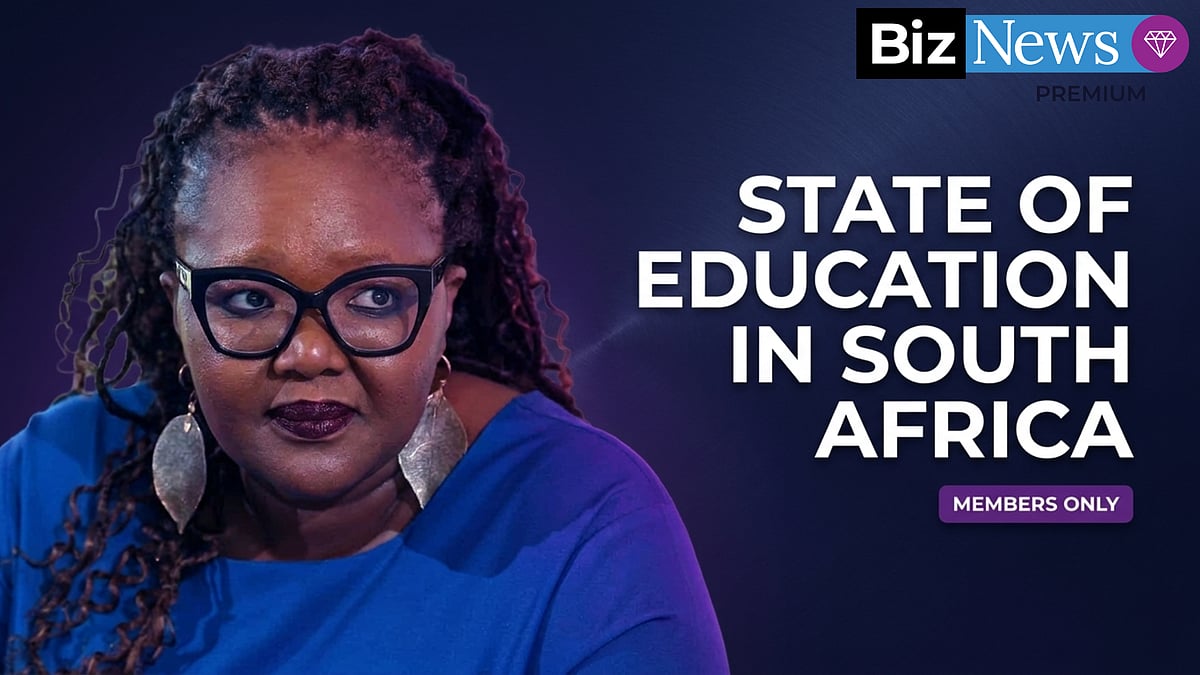
Siviwe Gwarube says South Africa’s education system needs long-term reform, not quick political wins. The Basic Education Minister discusses her first two years in office, tackling textbook procurement concerns, eliminating unsafe pit toilets identified in 2018, strengthening early childhood development, and navigating provincial delivery challenges. She argues the real measure of success lies in improving literacy and numeracy from the foundation phase, while defending the DA’s record in government and outlining why investing in young learners will shape South Africa’s future.
Sign up for your early morning brew of the BizNews Insider to keep you up to speed with the content that matters. The newsletter will land in your inbox every morning on weekdays. Register here.
Support South Africa’s bastion of independent journalism, offering balanced insights on investments, business, and the political economy, by joining BizNews Premium. Register here.
If you prefer WhatsApp for updates, sign up to the BizNews channel here.
Listen here
Edited transcript of the interview
00:06 – Alec Hogg
Well, the Democratic Alliance is very much in focus at the moment. As you heard from Frans Cronje when we spoke with him, he said that the governance story about the DA is really what they need to be focusing on.
One of the Democratic Alliance’s Cabinet members is Siviwe Gwarube, the Minister of Basic Education. Talk about a tough gig – that certainly is one. She joins us now to help us understand how things are going in her portfolio.
Minister, thank you. Lovely talking to you. You’ve been in the job now since mid-2024. From my research, you’re still in your mid-thirties, so it’s a heck of a portfolio, which we’ll get into in just a moment. Were you surprised when you were appointed to it?
00:57 – Siviwe Gwarube
Hello, Alec, and to your viewers as well.
I think South Africa generally was surprised. One of the perhaps untold stories is the rise of the MK Party, which obviously drove ANC support down quite severely. That opened an opportunity for the Democratic Alliance to find itself in national government.
When we did, we had to negotiate portfolios, and one of them was, of course, the Basic Education portfolio.
The funny story is that I actually had my eye on something else, but my party saw fit to ask me to be the Minister of Basic Education.
Looking back now, after two years, I think this has been the most challenging but also the most fulfilling portfolio I could have been part of because we get to shape South Africa’s future.
Whether we’re in government for two years, three years or five years, we will have planted seeds that will be very difficult to undo going forward.
02:28 – Alec Hogg
It’s a wonderful way of looking at it, and the contribution you can make to a whole new generation that will hopefully be looking after us in 20 or 30 years’ time.
But, just as an outsider – and you need to correct me here – I would have thought that Helen Zille would have been a shoo-in for this portfolio, given how involved and committed she has always been to education.
Was there any discussion around that, or why did the party decide the way that it did? Especially now that you’ve told us you actually had your eye on something else.
03:03 – Siviwe Gwarube
It was the leader’s decision.
At the time, John Steenhuisen, as leader of the Democratic Alliance, made the decision on who to field in the various portfolios. I’m glad he did. I think we’ve done some exciting things.
Also, bearing in mind that Helen was the Chair of the Federal Council at the time, she had her hands full, and I’m not entirely sure whether she was available for a Cabinet posting. Ultimately, though, the decision was John’s to make.
03:50 – Alec Hogg
Have you engaged with her much since moving into this huge portfolio, which is so important and carries so much responsibility for your party?
04:00 – Siviwe Gwarube
Absolutely.
One of the things Helen feels very passionate about is what she calls the five Ts: time on task, teaching, textbooks, testing and technology.
We had many discussions about how to improve quality in the system, how to hold people accountable, and how to ensure that we place the interests of learners and teachers at the centre of what we do, rather than the interests of trade unions, for instance.
She had a great deal of experience with that, so we had many discussions. She was also instrumental in getting me to think about a lot of things and recommended many people for me to meet.
What I did during my first six months in the job was make sure that I listened and learned. That’s why we had a listening and learning tour across all nine provinces.
I was committed to recognising that there’s a lot of wisdom in listening to people who’ve done this work and who are in the sector, and to having the humility to say, “I don’t know what I don’t know.”
So I engaged with anyone in the sector – academics, practitioners and even former politicians who had done this work.
I even met with my predecessor, Minister Angie Motshekga. I was really open to understanding the sector and understanding it well.
It was very important to me that the first six months of my term were dedicated to having the humility to say, “I want to learn.”
05:53 – Alec Hogg
That is so important.
In the corporate world, when new CEOs come in, you can tell exactly what kind of CEO they’re going to be by what they do in the first six months. It’s even more obvious with a new board member. If they’re trying to dominate proceedings instead of simply listening for the first three board meetings, you know what kind of person you’ve got.
So that’s good news.
You mentioned textbooks. What went on there? It’s your department now – you’re the head of it – and there have been allegations of corruption around textbook procurement. You’ve initiated an investigation.
Was that simply something that came with the territory because, as I mentioned at the outset, it’s such a tough portfolio?
06:36 – Siviwe Gwarube
Look, the truth of the matter is that the textbook procurement process is very much removed from the Minister. It started in early 2024, before I arrived, and it’s conducted through what the department calls a blind screening process by a number of experts who assess what ought to go into the curriculum.
As soon as I received a whistleblower complaint last year, in 2025, alleging that an individual within the department had tipped off potential bidders, we instituted a forensic investigation. That investigation did not find conclusive evidence to support the allegation, so that was the first step.
Perhaps many people don’t realise that I’ve been paying very close attention to this process because two things are important to me.
Firstly, the integrity of the process. Secondly, ensuring that children receive their textbooks on time in 2027.
The Foundation Phase is one of my key priorities, so I have a keen interest in understanding the quality of what goes into the catalogue.
When the final three publishers were selected, there was considerable uproar within the publishing industry, along with a number of media reports.
07:39 – Alec Hogg
You got the attention first.
08:06 – Siviwe Gwarube
At that point, I said we needed to pause the process for two reasons.
Firstly, to allow the internal audit unit to examine the process, particularly the procurement model and what had been done.
Secondly – and I know some people criticised this decision – I approached my colleague, Minister Enoch Godongwana, because what people often don’t realise is that procurement law falls squarely within the core responsibility of the National Treasury.
When you’re trying to establish whether the correct process was followed in terms of the Public Finance Management Act (PFMA) and other procurement legislation, Treasury is the appropriate authority.
When Treasury came back to me and said they were unable to determine whether the process had been above board because they had not had sufficient time to review it, it became clear that we needed an independent forensic investigation into the process. I wasn’t entirely satisfied that everything had been conducted properly.
The reason this is so important isn’t only about the delivery of textbooks, Alec. If provinces procure textbooks through a flawed procurement model, they could find themselves incurring unauthorised expenditure.
So I also have to protect the interests of the nine provinces that will ultimately be procuring through this process.
As much as I would have liked the process to be concluded as quickly as possible, I cannot proceed…
09:51 – Siviwe Gwarube
…until I’m 100% certain that an independent investigator has examined the process and can certify that nothing untoward has taken place.
I’m also interested in issues such as publisher capacity. Previously, I’m told the department didn’t necessarily assess whether a publisher had the demonstrated capacity to deliver.
Surely, when selecting publishers, we should be looking at their track record and whether they have proven they can fulfil the contract.
Those are among the issues I’ve asked the independent investigators to examine so they can determine whether we are, in fact, on the right footing.
That’s very important to me because this isn’t just about a particular price tag. It’s about protecting provincial finances and ensuring that the procurement process has been conducted with integrity.
10:53 – Alec Hogg
Hmm. I want to return to the provinces in just a moment, but one thing that struck me while researching for this conversation is how many parallels there are with John Steenhuisen, your former leader.
He inherited a very tough department. He had foot-and-mouth disease, which many people believe he completely botched.
On your watch, you’ve had the pit toilet issue, which is just as emotive for South Africans.
Now, it’s very good news that all the pit toilets identified on the 2018 list have now been replaced. You’ve said that’s a 100% success. But how many others are there around the country?
There was some criticism, with people saying, “Hang on, we haven’t dealt with all the pit toilets yet.”
Have you got any insight into that?
11:42 – Siviwe Gwarube
It was very important for me to report on the progress, and I was a little taken aback by some of the reaction, to be honest with you.
We were very responsible in the way we reported progress on completing the SAFE Initiative. We were very clear that we had completed 3,372 sanitation projects identified in 2018.
By no means does that mean there are no more pit toilets in South Africa.
For instance, I know that provinces such as the Eastern Cape, KwaZulu-Natal and Limpopo have been working very hard to eliminate their backlogs, particularly because they were delivering against a court order following the tragic death of Michael Komape.
There are still pit toilets that were either missed in the 2018 audit or have emerged since then.
I’ve often said that infrastructure is a moving target. No Minister in their right mind would ever declare that there are no unsafe structures across 24,000 schools. That would be completely irresponsible.
So I was a little surprised because we went to great lengths to explain that completing those 3,372 projects was a significant milestone, but it certainly doesn’t mean the work is finished.
The Education Infrastructure Grant, worth R16 billion, has been allocated to provinces to continue addressing unsafe infrastructure—whether that’s classrooms, roofs, windows or toilets.
That work continues.
For example, I was in Mthatha in the Eastern Cape earlier this week, where the province indicated that it is working very hard to complete all remaining pit toilet projects during the current financial year.
13:36 – Siviwe Gwarube
I’ve been very clear that this does not mean there isn’t a single unsafe structure remaining, and I would never make that declaration because you simply don’t know what can happen at school level.
One of the most heartbreaking things I encountered was during a visit to the Vhembe District last year.
Teachers told me, “We can’t rely on municipal water.” So even though flushing toilets had been installed, they wanted to keep the pit toilets because they feared the municipality could stop supplying water, leaving them unable to use the new facilities.
That means we’ve had to explore alternative waterless sanitation solutions for schools where municipalities are failing to provide reliable services.
That’s why I say it would be absolutely irresponsible to claim there isn’t a single unsafe structure anywhere in the system.
If anything were to happen to one of the 13.7 million learners in our schools, I would have to answer for it.
14:35 – Alec Hogg
Yes, we have a country with many, many challenges, and you’ve articulated that very well.
But the challenge you’ve really taken to heart – the one I’m sure you’ll be waving the flag for, and your party will as well – is…
14:58 – Alec Hogg
…is early education, early childhood development.
You’ve had a lot of success there, even better than you anticipated initially. What’s the reason for that? And has that just been something that the whole department has concentrated on because it is really that important to get the little ones to have the right start in life?
15:18 – Siviwe Gwarube
Yes, look, I think I articulate it by saying this:
South Africa has often been obsessed with one single metric, which is essentially the matric pass rate and the matric pass mark at the end of the year.
My view is that this is an exit indicator. It doesn’t tell you much of what you need to know about the health of your system because, whatever the pass mark is, you are looking at what has happened in the past.
Whatever your throughput rate is – which is sitting at about 68% for South Africa, which is consistent with middle-income countries – it is fine, but it doesn’t tell you what you need to know in order to improve.
So my view was that we need to invert the system, almost like inverting a pyramid. We need to say that the most important years are actually from zero to five, and five to ten.
Because if you miss learning opportunities, if you experience learning losses there, that is why you then start obsessing about whether our children are taking mathematics and science, and whether our children are able to read for meaning.
You’ve missed an opportunity to make sure that the structured ECD centres and the Foundation Phase are really solid, with good teachers and good textbooks.
Essentially, we need to make sure that primary schools are strengthened.
If you get the first ten years right, you never have to worry about what your matric pass rate is or whether children are taking mathematics and science, because they will.
We missed those opportunities to our own detriment, and that is why we’ve got a relatively poor uptake of mathematics, science and technology, which we call STEM subjects.
Because if children can’t read for meaning, they are not confident in taking on gateway subjects.
That is why there has been an absolute obsession for me about the first ten years of a child’s life, because that’s where we need to make the biggest investment.
That is also why, with the bursaries that the DBE distributes, we’re now making sure that over 60% of those bursaries go to Foundation Phase teachers.
For a very long time, Foundation Phase teachers were seen as the lesser educators and not as the core of what needs to happen. Yet it is such a specialised skill to teach the Foundation Phase. It is a highly specialised skill.
That has been the obsession, and that’s why I’m saying that we are planting seeds that we may not necessarily stand under the shade of.
17:44 – Alec Hogg
A nice field to teach Foundation Phase, but especially nice if you can see the rest of the beginning of the process. And that’s why I’m saying I think the seeds that we’re planting are not necessarily something that we will see the shape of immediately, but I believe that the kids who are in ECD right now, who are in Grade R right now, will be far better than the children already in our system.
18:06 – Alec Hogg
That’s a really uplifting message that’s coming through on that side.
Not so uplifting, though, is the stuff going on in the provinces. I guess your former leader bemoaned the fact that the provincial rollout of the FMD vaccines was part of the big problem for him.
From your perspective, how does it all work within Basic Education? How much can you control, and how much is actually outside of your control and in provincial hands?
18:38 – Siviwe Gwarube
Yes.
Look, it is a concurrent function. I suppose the same thing applies to Human Settlements and the Department of Health, because concurrent functions are as envisioned in our Constitution.
As the Department of Basic Education, we essentially set the framework for the sector. We set the policies and regulations.
All the legislation would come from us, and we basically set the framework for the sector.
But when it comes to actual delivery, that is a provincial competency.
We essentially disburse what we call conditional grants. There are certain things that we would not just allow provinces to decide on.
School nutrition is one of them. Infrastructure is another. The Mathematics, Science and Technology Grant is another. Learners with special or profound disabilities is another.
Those are examples of conditional grants that come through National Treasury and through us, and provinces have no choice but to spend that money on those specific areas.
However, much of the delivery in provinces comes from the equitable share.
To be fair to most provinces, most spend upwards of 45% of their entire equitable share on education.
20:09 – Siviwe Gwarube
The decision on how much you allocate to scholar transport, how much you allocate to building schools, and how much you allocate to expanding schools remains a provincial competency.
While we have what we call MINMEC – the Council of Education Ministers – which is a legislated structure, and we have a cooperative relationship, what many South Africans don’t understand is that MECs don’t report to the National Minister.
They report to their Premiers.
So you must work with them and say: “Look, you’re not spending your conditional grants. You are failing here. How can we assist? How can we support?”
One of the things that I have found, Alec, which has been really difficult to deal with, has been provincial finances.
We find that provinces either have accruals or are indebted. Therefore, every time they receive a new budget, they have to pay their creditors from the previous financial year.
That is why this year we have been agonising over how we support provinces to get out of the red and out of debt.
One of the things we are going to introduce is a multidisciplinary team that will essentially go into provinces and say: “Take us through your books. Let us see where you are going wrong. What can you do here? Can you prioritise this over that?”
We are trying, by all means, to ensure that we influence but also assist, because our role, according to legislation, is also monitoring and support.
Supporting is difficult because sometimes there is an inclination to want to control.
21:41 – Alec Hogg
We are trying to help, but also assist, because our role is not to make decisions; we also have to manage our own responsibilities. So supporting is hard because sometimes there is an inclination to want to control.
But I think then, you know, you have to work with your colleagues to say, look, the admissions policy or the online applications in Gauteng—people often bemoan them.
You have to work with Gauteng to say: how do we make it user-friendly? How do we make sure that parents are not frustrated at the beginning of the year?
The Western Cape deals with late applications all the time when it comes to January. So often I would sit with the MECs by September already and say: how are you planning for your admissions pressures in the year?
So that’s how it works.
I think I’ve got a really good relationship with all nine MECs. Well, now that David Maynier has left, with all nine MECs, I’ve had a really great working relationship with them because I think they’ve realised that my obsession is not the politics, but the sector.
I’ve made it clear to them that any time something happens in your province, I am held accountable, but a lot of it is actually your responsibility.
22:57 – Alec Hogg
That’s an interesting point, David Maynier leaving, because the Western Cape and other parts of the country have really been put under pressure through this emigration.
Often when one talks about emigration, you think of rich people coming from Johannesburg and Pretoria and moving down to Cape Town. But actually, this emigration that’s happening is coming from rural areas as well, and that has got to be putting much more pressure on existing structures.
How do you balance the need to invest in taking care of those children?
And I think an associated question, now that illegal foreigners are a big story: how do you also make sure – or do you – that the children of illegal foreigners are not taking places that would be available, or should be available, for South Africans?
I know these are really tricky issues, but how do you grapple with that?
23:58 – Siviwe Gwarube
Yes, look, that’s a very important point.
This is what I often say to my colleagues: the reason why we have to be so obsessive about injecting quality into our education system is because the majority of schools are actually Quintile 1 to 3 schools.
The work that we do here – the majority of it, about 90% of the work that we do – is for poor Black South Africans, because most affluent South Africans are able to buy themselves out of the public education system. They send their children to private schools.
That is why I get very frustrated when people seem to have a lacklustre attitude towards the work that we have to do, because we are responding to a pressure that most South Africans cannot buy themselves out of.
So, when you talk about the movement of people into bigger cities, Gauteng and the Western Cape have experienced this sharply.
The reason why they do is because South Africans are leaving rural areas because there is no economic opportunity.
So we become the recipient of pressure that has been caused by a failure in another sphere of government.
Because if local municipalities were working, and working well, people would be able to create meaningful, dignified lives where they are. But they can’t, and they have to move to cities to make something for themselves.
Then we have to make sure that, in those provinces, we cater for those children.
Similarly, on the issue of illegal immigration or foreign children, the truth of the matter is – and I’ve been at pains to explain this to people – that only 1.6% of children in our system are foreign nationals.
25:51 – Siviwe Gwarube
So we’ve got 13.7 million South African children in the system, and only 1.6% of those are foreign nationals.
Another thing that I think is very difficult for people to understand – and again, it goes back to the point I’m making about when you fail in one sphere, it has a ripple effect on others.
26:18 – Alec Hogg
Because it’s amazing.
26:17 – Siviwe Gwarube
South Africans, in my view, are not intrinsically xenophobic. South Africans are frustrated.
They are frustrated because it takes hours for them to get into a clinic. It is difficult for them to get their children into schools because of the pressures. Jobs are hard to come by.
Young people in South Africa face enormous unemployment challenges. Almost half of young people are unemployed.
I think the frustration is mostly because people feel: “I can’t make a life for myself, and it feels as though the person who comes from another country is able to do so.”
That is often what we have to deal with.
What I often explain to people is that Section 29 of the Constitution is unequivocal in saying every single child has a right to education. It does not say every South African child.
This was also affirmed by a High Court judgment in 2019, where the court said that many South African children themselves are undocumented.
So if you start talking about documentation or no documentation, you are going to start discriminating against children who are not responsible for whether or not they are documented.
We have many stories of children who were raised by grandmothers because their mothers or fathers walked away, and they are not documented.
One of the things we have been looking at through some of the data is how many South African children are undocumented.
That is also why we want to bring Home Affairs closer into our processes, and why this inter-ministerial committee with other departments for ECD is important, so that we can start documenting children even at ECD level.
These are complicated issues, but I think what ought to happen is that we must always be guided by key principles of humanity and remain committed to the principles of our Constitution.
27:50 – Alec Hogg
So that’s also why we wanted to process our process like the same thing.
28:01 – Alec Hogg
So they didn’t know that a lot of different ways of ways, but then I think it’s almost…
28:17 – Siviwe Gwarube
We will fare well if we do that.
And then we, as leaders who have been elected, all need to play our part. We all need to do our part, whether you’re in local government, provincial government or national government.
Because when one sphere of government fails, it has a ripple effect on everybody else.
I come from the Eastern Cape, so I have seen the profound failure of local government where I come from. My town looks like a shadow of its former self from when I used to live there in Buffalo City.
I can see that no young person would want to live in Buffalo City. It’s not possible.
So, yes, I really am passionate about people. All of us need to play our part.
28:56 – Alec Hogg
I trust myself on that before.
It’s a very important point that you make there. Thanks for doing that again.
I spoke yesterday to Frans Cronje, and I need to get your response to this because he started talking about agriculture being in a mess with John Steenhuisen, and he said the DA ministers haven’t really shone.
He then said education is in a mess and went on to the other departments.
How would you react to that kind of criticism?
29:30 – Siviwe Gwarube
I think people are at liberty to criticise as much as possible.
I also think that one of the things we, as a party, have learned – and perhaps Frans could gain from this – is that we’ve always understood that education is going to be an investment.
I’m not in the business of cutting ribbons.
So, if your parameter for success is how many ribbons you are cutting or how many schools you are handing over, then there is a misunderstanding of what a National Minister ought to do and what the National Minister is responsible for.
You have to understand that you are changing a system. These are system-led changes.
They are going to take time to yield fruit. They are going to take time for us to see children thriving by five. It is going to take time for children to start reading for meaning and for us to bring down that number of eight out of ten children who can’t read for meaning.
Those are the things we are obsessing about.
I’m less obsessed about opening a school somewhere, but I am mostly focused on whether the curriculum branch in the department is looking at what ways we can use to teach Foundation Phase mathematics.
Are we doing the right thing? What is the rest of the world doing to make sure that we are teaching Foundation Phase mathematics well, so that children can thrive?
The DA had to come to terms with that.
I’m glad you asked this question because often people say there are no good stories coming from the department.
Of course, this is one of those departments where you are responsible for 13.7 million children. If anything happens to any one of them, you have to answer.
There are 24,000 schools and half a million teachers.
It is a big system with delegated powers and concurrent powers, which limits your ability to control certain things.
But at the end of the day, Alec, I think…
31:27 – Alec Hogg
And delegated powers have created challenges, which limits your ability to control other things. In a way, I think you want people to understand that it’s an investment in the future.
People get pretty deep into trends and say it’s a complete mess.
31:36 – Siviwe Gwarube
You’ve got to understand that an investment means you are investing now for a future outcome.
I would say to Frans that it would be really deeply unfair to say it’s a mess after only two years of having taken on the role.
I think he can judge the performance of my term when we leave, and whether or not the inversion of the pyramid – the reorientation of the Basic Education sector – is actually what we needed to do.
I personally think that he may start to agree that this is what we needed to do.
32:20 – Alec Hogg
Maybe looking through a different lens, as you say, through an investment lens.
Just to close off with a bit of politics: how has the John Steenhuisen interview landed in the DA?
You were right in the heart of the organisation, the spokesperson for so long. People know you as the face of the organisation. If anybody knows what the impact would be, it would be you.
32:46 – Siviwe Gwarube
Yeah, look, I mean, I think…
Alec Hogg (10:53.611)
Hmm. I want to return to provinces in just a moment, but the one thing that struck me in doing the research before this conversation is how many parallels there are with John Steenhuisen, your former leader. He inherited a really tough department. He had foot-and-mouth disease, which everybody seems to think he completely botched. On your watch, you had the pit toilets, which are as emotional for South Africans as the foot-and-mouth disease.
Now, it’s very good news that the 2018 list – those identified in 2018 – all those pit toilets have now, you’ve told us, been sorted out. A hundred percent success. But how many others are there around the country? Because there was some criticism to say, hang on, we haven’t done with all the pit toilets yet. Have you got any insight on that?
Siviwe Gwarube (11:42.386)
Look, it was very important for me to obviously report on the progress. I was a little taken aback, to be honest with you. I mean, we were very responsible with how we reported the progress on completing the SAFE initiative.
We were very responsible. We were very quick to say we’ve completed 3,372 toilets as of date, which were identified in 2018. This by no means means that there are no more pit toilets in South Africa.
For instance, I know that there are provinces like the Eastern Cape, KwaZulu-Natal, Lesotho and Limpopo – because remember, they were delivering against a court order following the death of Michael Komape – so they have been really pushing very hard to make sure that they clear all their backlogs.
But there are still some pit toilets which were either missed in 2018 or have since mushroomed since then.
And I’ve been very amazed also at pains I like to say: infrastructure is a moving target. No minister in their right mind would ever say there’s no unsafe structure in 24,000 schools. I would be completely irresponsible.
And so I was, as I said, a little bit taken aback, because we were very much at pains to say we’ve completed this, and it’s a milestone on its own, but it doesn’t mean that the Education Infrastructure Grant — R16 billion of which has been allocated to provinces to make sure that they clear any unsafe infrastructure, be it classrooms, roofs, windows or toilets — it doesn’t mean that it takes away from that work that still needs to be done.
I know, for instance, that the province of the Eastern Cape, when I was there — because I was in Mthatha earlier this week — indicated to me that they are working very hard to complete whatever toilets are still left in the current financial year.
So I’ve been very clear that this by no means means that there isn’t an unsafe structure. And it would — I would never actually make that declaration at all, because you don’t know what happens at a school level.
One of the things that I found really heartbreaking when I was in the Vhembe district last year was that teachers were saying, “Look, we can’t rely on municipal water.”
And so even though you’ve installed these flushing toilets, we still want to keep our pit toilets because we know that the municipality can stop this water, and then we wouldn’t be able to flush.
So we’ve had to look at also other waterless solutions to help where municipalities are not coming to the fore.
But that’s why I’m saying it would be absolutely irresponsible to say there’s not a single unsafe structure in any school, because you would then have to answer if anything happened to any child, of which there are 13.7 million.
Alec Hogg (14:35.301)
Yeah, we’ve got a country with lots and lots of challenges, and you’ve just articulated that really well.
But that big challenge, the one that you’ve really taken to your heart, and the one that actually you will be waving flags about – I’m sure your whole party will be waving flags about is the…
Alec Hogg (21:41.947)
We are trying by helping, but also assisting, because our role is – as we also manage our books. So supporting is hard because sometimes we have the inclination to learn control. But I think then, you know, we have to work with the parties to say, the admission policy or the, you know…
Siviwe Gwarube (21:55.744)
But you then have to work with your colleagues to say, look, the admissions policy or the online applications in Gauteng – people often bemoan them. So you have to work with Gauteng to say, how do we make it user-friendly? How do we make sure that parents are not frustrated at the beginning of the year?
The Western Cape deals with late applications all the time when it comes to January. So often I would sit with the MECs by September already to say, “How are you planning for your admissions pressures in the year?”
So that’s how it works.
I think I’ve got a really good relationship with all nine MECs. Well, now David Maynier has left. With all nine MECs, I’ve had a really great working relationship with them because I think they’ve realised that my obsession is not the politics, but the sector.
And I’ve made it clear to them that any time that anything happens in your province, I’m held accountable, but a lot of it is actually your responsibility.
Alec Hogg (22:57.986)
That’s an interesting point, David Maynier leaving, because the Western Cape and there are other parts of the country as well, has really been put under pressure through this emigration.
And often when one talks emigration, you think rich people coming from Johannesburg and Pretoria and then moving down to Cape Town. But actually, this emigration that’s happening, a lot of it’s coming from the rural areas, and that has got to be putting a lot of pressure on existing structures.
How do you balance the need to invest in taking care of those kids? And I think an associated question now that illegal foreigners is a big story: how do you also make sure, or do you, that the children of illegal foreigners are not taking places that would be available or should be available for legal South Africans?
I know these are really tricky issues, but how do you grapple with that?
Siviwe Gwarube (23:58.322)
Yeah, look, I mean, that’s a very important point. And this is what I often say to my colleagues: the reason why we have to be so obsessive about injecting quality into our education system is because the majority of schools are actually quintiles one to three schools.
So the work that we do here – the majority of it, 90% of the work that we do here – is for poor black South Africans, because most affluent South Africans are able to buy themselves out of the public education system. They send their kids to private schools.
So that is why I get very frustrated when people seem to have a lacklustre attitude to the work that we’ve got to do, because actually we are responding to a pressure that most South Africans can’t buy themselves out of.
So you talk about the movement of people into bigger cities. Gauteng and Western Cape experience this sharply, and the reason why they do is because South Africans are leaving their rural areas because there’s no economic opportunity.
So we become the recipient of a pressure that has been a failure by another sphere of government.
Because if local municipalities were working and they were working well, people would be able to create lives – meaningful, dignified lives – where they are.
But they can’t. And they have to move to cities so that they can make something for themselves.
And then we have to make sure that in those provinces, we cater for those children.
Similarly, the issue around illegal immigration or foreign children. The truth of the matter is, and I’ve been at pains to also explain to people, that only 1.6% of children in our system are foreigners.
So we’ve got 13.7 million South African children in the system, and only 1.6% of that are actually foreign nationals.
And now another thing is that I think is very difficult for people to understand – and again, I think it goes back to the point I’m making about when you fail in one sphere, it’s got a ripple effect on others.
Alec Hogg (25:55.391)
Because it’s amazing.
Siviwe Gwarube (26:17.680)
Because South Africans, in my view, are not intrinsically xenophobic. South Africans are frustrated.
They’re frustrated because it takes hours for them to get into a clinic. It’s hard for them to get their children into a school because of the pressures. Jobs are hard to come by.
Young people — almost half of the young people in South Africa — are unemployed. Seven out of ten young people in South Africa are unemployed.
So I think the frustration is mostly because I can’t make a life for myself. And it feels as though the person who comes from another country is able to do so.
And that is often what we have to deal with.
And what I often explain to people is that Section 29 of the Constitution is unequivocal about saying every single child has a right to education. It doesn’t say every South African child.
And this was also affirmed by a High Court judgment in 2019 where the court said your own South African children, many of them are undocumented.
So if you start talking about documentation or not documentation, you’re going to start discriminating against children who are not responsible for whether or not they are documented.
We’ve got many stories of children who were raised by grandmothers, where moms and dads walked out, and they are not documented.
And one of the things that we’ve been looking at — some of the data we’ve been looking at — is how many South African children are undocumented.
That’s also why we want to bring Home Affairs closer to our process, and that’s why this inter-ministerial committee with other departments for ECD is important, so that we can start documenting children even at ECD level.
So yes, you’re right, these are complicated issues. But I think what ought to happen is we must always be guided by key principles of humanity, of really being committed to the principles of our Constitution.
I think we will fare well if we do that.
And then we all, as leaders who have been elected, need to pull our part. We all need to do our part, whether you’re local government, provincial government, national government.
Because when one sphere of government fails, it has a ripple effect on everybody else.
And I come from the Eastern Cape, so I have seen the profound failure of local government where I come from.
My town looks a shadow of its former self from when I used to live there in Buffalo City.
I can see that no young person would want to live in Buffalo City. It’s not possible.
So, yeah, I really am passionate about people. All of us need to pull our parts.
Alec Hogg (28:56.339)
So I know I trust myself on before.
It’s a very important point that you make there. Thanks for doing that again.
I spoke yesterday to Franz Cronje, and I need to get your response to this because he started talking about agriculture being in a mess with John Steenhuisen, and he said, yes, and the DA ministers haven’t really shone.
He then said education is in a mess, and then went on to the other departments. How would you react to that kind of criticism?
Siviwe Gwarube (29:30.970)
I think people are at liberty to criticise as much as possible.
I also think that one of the things I think, as a party, we’ve learned — and perhaps maybe Franz could gain from this — is we’ve always understood that education is going to be an investment.
I’m not in the business of cutting ribbons.
So if your parameter for success is how many ribbons you are cutting, how many schools you’re handing over, then there’s a misunderstanding of what the national minister ought to do and what the national minister is responsible for.
And so we’ve got to understand that you are changing a system. It’s system-led change.
They’re going to take time to yield fruit. They’re going to take time for us to see children thriving by five.
It’s going to take time for children to start reading for meaning and for us bringing down that number of eight out of ten children who can’t read for meaning.
Those are the things we are obsessing — I’m obsessing — about.
I’m less obsessed about opening a school somewhere, but I’m mostly obsessed about whether the curriculum branch in the department is looking at what ways we can utilise to teach foundation phase maths.
Are we doing the right thing? What is the rest of the world doing to make sure that we are teaching foundation phase maths well so that children can thrive?
And the DA had to come to terms with that.
And I’m glad you asked this question because often people say, “But there are no good stories that come from the department.”
Of course, this is one of those departments where you’re responsible for 13.7 million children. If anything happens to any of them, you have to answer.
24,000 schools, half a million teachers.
So it’s a big system that has got delegated powers, concurrent powers, which limits your ability to control certain things.
But at the end of the day, Alec, I think you’ve got to understand that an investment is that you are investing now for a future outcome.
So I would say to Franz it would be really deeply unfair to try and say it’s a mess in two years of having taken on the role.
I think that maybe he can judge the performance of my term when we leave, and whether or not the inversion of the pyramid — the reorientation of the basic education sector — is actually what we needed to do.
And I personally think that he may start to agree that that’s what we needed to do.
Alec Hogg
Minister, just to finish off on a political issue, you are right in the heart of the DA, having been the spokesperson, the face of the party for a long time.
Now the interview that your former leader had is all kinds of speculation about the knock-on effect for the DA in the elections just around the corner.
All kinds of speculation on why is he staying as a deputy minister when he’s blown up the place.
What’s your read on all of this, given that you’re probably the best person in the organisation to be able to help us, because that’s an area where you’re an expert in?
Siviwe Gwarube (38:13.572)
Look, I think firstly, it was important for John to set the record straight about especially his performance as the Minister of Agriculture and his handling of FMD.
And I think it would have been deeply unfair to say that he ought not to account for his time.
But I think my wish, Alec, really is that if we are going to be the biggest party in 2029, I really want us to focus a lot more on our voters and what our voters and South African voters need to encourage them to come out to vote.
Because ultimately, if we are too inward-facing, voters are turned off by that.
They are saying, “Well, you are mostly focused on your own drama, and you’re not talking about how you’re going to create jobs should you be in office.”
And that’s why I decided to put my hat in the ring back in April and say, “I want to be part of the leadership of this organisation, because I can’t outsource the growing of the party to other people if I’m not prepared to be part of the solution.”
So I think that is part of the reason why I wanted to be a deputy chairperson.
And so I really want to urge my party, I think, when we do meet as the leadership, to say we need to be focused on performing very well in this local government election.
But then we need to have our eye on 2029 because, in my view, I think South Africa’s best chance is having the DA being the biggest party come 2029 and perhaps even looking at a different formation of a government of national unity or a coalition government.
I think that we are at a place where we can do that, but it will be ours to lose.
And so it’s very important that we become outward-focused and about winning votes.
Alec Hogg (40:21.333)
So if I read you correctly, you say that John Steenhuisen had every right to do that interview?
Siviwe Gwarube (40:29.060)
Well, I’m saying he has a right to talk about his time as the Minister of Agriculture and his handling of FMD and other issues.
If I suppose if I were to leave my portfolio, I would want to reflect on my time here and what I did and some of the lessons that I’ve learned.
And I think it would have been unfair to not expect him to be able to have a reflection.
What has transpired — look, I am not in a position to be able to talk to the issues that have come out of that interview because I have not had any interactions with any of those individuals or that company.
For me, it’s difficult to weigh in on something that I am not part of or I wasn’t privy to.
But as I said, I think any person who has put in two years of work would want to be able to reflect on what they’ve done.
But I think it’s important that, as a party now, we shift our gaze mostly to November 3rd and how we’re going to enthuse voters who’ve never voted for the DA before.
And one of the key things, Alec, in my view, is we need to move away from just being a party of competence, but being also a party of compassion.
And that also means saying we understand where people are coming from, their frustrations, and what are we going to do about it?
Because ultimately, we can’t also just only rely on clean audits and say, “We’ve got to be a compassionate organisation where people can say, ‘I see myself reflected there.’”
I see that these are people who understand my realities.
And so, I think, as being the most diverse political party in South Africa, we can do that.
So that’s why I’m saying it would be ours to lose to being the biggest party in 2029.
We can achieve it, but we need to be a lot more focused and turn our gaze towards the voters and less so on ourselves.
Leave a Reply