
Cape Town is booming. Cranes dominate the skyline, global investors are pouring in, and South Africa’s oldest city is increasingly eclipsing Johannesburg as the country’s economic powerhouse. From Amazon’s new African headquarters to a thriving tech ecosystem and surging property market, confidence in the Mother City appears stronger than ever. But beneath the success story lies a more complicated reality. Deep inequality, persistent spatial divides and questions about who truly benefits from the city’s growth continue to cast a long shadow. Is Cape Town becoming a model for South Africa’s future, or merely a tale of two cities?
By Prinesha Naidoo and Antony Sguazzin
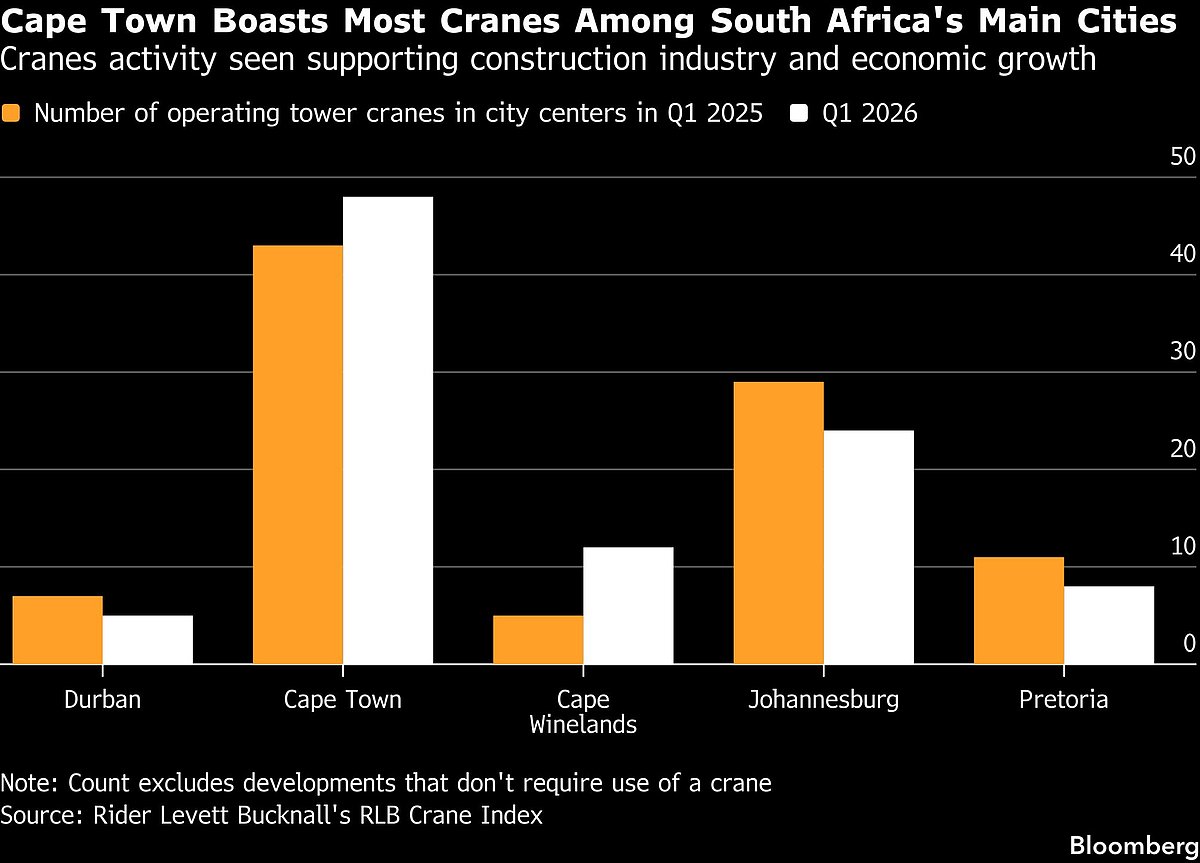
Confidence in Cape Town is being written in its skyline.
Amazon.com Inc. has built a $250 million Africa headquarters at the foot of Table Mountain. Buyers are shelling out more than $3 million apiece for apartments near a planned billion-dollar expansion of the prized V&A Waterfront district, where Marriott International Inc. is set to open its most luxurious hotel on the continent.
For 250 years after the first ships from the Dutch East India Company landed at the Cape of Good Hope, the city sat at the heart of South Africa’s economy. Then, in 1886, the discovery of the world’s biggest gold field shifted capital inland. Johannesburg was born and soon eclipsed the coastal city.
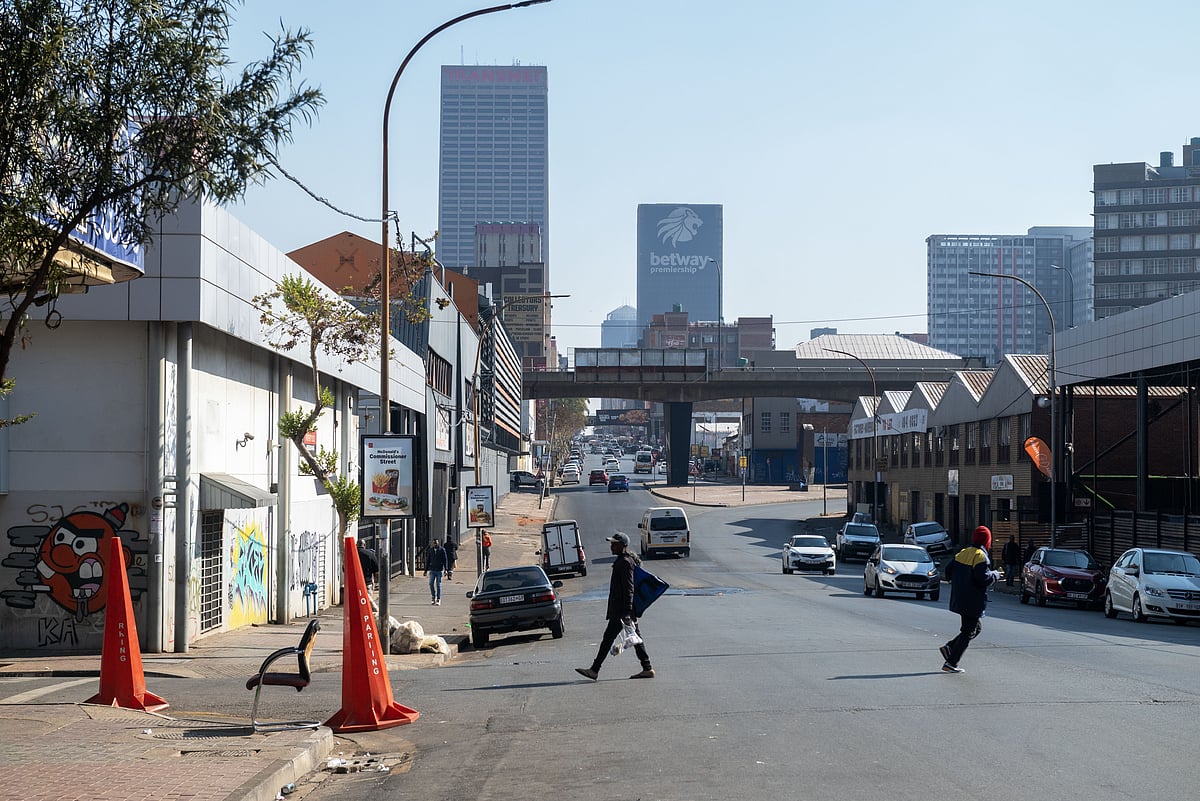
Now, the pendulum is swinging again. Johannesburg is grappling with stalled projects, corruption scandals and fiscal strain, while Cape Town booms. Their diverging fortunes reflect a broader reshaping of Africa’s biggest economy.
Growth in the Western Cape province, where Cape Town accounts for about 72% of output, outpaced the national average in 2025. The city has the lowest unemployment rate of all the country’s metros and last year added more jobs than any other major hub, helping fuel migration and drive up property prices. It has also overtaken Johannesburg to become the South African city with the most taxpayers.
Investors are “taking a bet on the future,” Mayor Geordin Hill-Lewis of the Democratic Alliance told Bloomberg News. The city “has good public services and a stable, trustworthy government,” he said from the stands of a 55,000-seat stadium in Cape Town which has hosted HSBC SVNS rugby tournaments and an Ed Sheeran concert.
“It has all the ingredients to make it an attractive place to live.”
But even as capital, skilled workers and migrants arrive at a pace unmatched across South Africa, inequality remains a central concern. After more than three decades of democratic rule, the country still ranks as one of the world’s most unequal, and townships — where apartheid governments forcibly relocated people of color — remain among the poorest, most violent and underserved areas.
In a 2023 report, the Centre for Sustainable, Healthy and Learning Cities and Neighborhoods called Cape Town “deeply polarized and segregated,” noting that sections of the population lacked access to basic water and sanitation services. “Public services help moderate some of these inequalities, but their reach and quality are also very uneven across the city,” researchers said.
The imbalance is visible elsewhere too. Cape Town’s political and business elite are disproportionately White relative to other major South African cities. Hill-Lewis, elected as national head of his party two months ago, pushed back against that critique. “You need to elect a capable government regardless of who the people are or what they look like,” he said.
In November, Helen Zille, the White former mayor of Cape Town, will lead the DA’s bid to take control of Johannesburg. The party is leading in the polls and will likely lean on its track record in Cape Town, which, for all its problems, remains a rare bright spot in South Africa’s economy.
It has a population of about 4.8 million, almost identical to Johannesburg’s, and a smaller budget, yet spends roughly twice as much on infrastructure investment and maintenance.
“Contrasting Johannesburg and Cape Town, you would swear you were in two different countries,” said Busisiwe Mavuso, the chief executive officer of the prominent lobby group Business Leadership South Africa.
Led by the DA since 2006, Cape Town has benefited from policy certainty and is the only one of South Africa’s eight largest metros to receive clean audits over the past three years. Johannesburg, by contrast, has been helmed by unstable coalitions and 10 mayors in the past decade — including from the DA — and now risks losing state funding because of what the finance minister termed irresponsible spending.
Its role as a financial center is being gradually eroded as ultra-rich South Africans, including business figures, increasingly base themselves in and around Cape Town, which lies more than 1,400 kilometers (870 miles) to the southwest.
The coastal city is on track to surpass Johannesburg as Africa’s hub for millionaires by 2030, according to Henley & Partners’ Africa Wealth Report, and its growing technology and startup ecosystem have earned it the moniker Silicon Cape.
Yet the influx of wealth has also sharpened questions over who actually benefits from Cape Town’s growth. Family offices and venture capitalists are pouring into the city, and business process outsourcing has emerged as a fast-growing industry, but manufacturing, a key source of jobs for lower-skilled workers, continues to struggle. Many residents remain concentrated in peripheral townships far from opportunity, while wealth is clustered in a handful of affluent corridors.
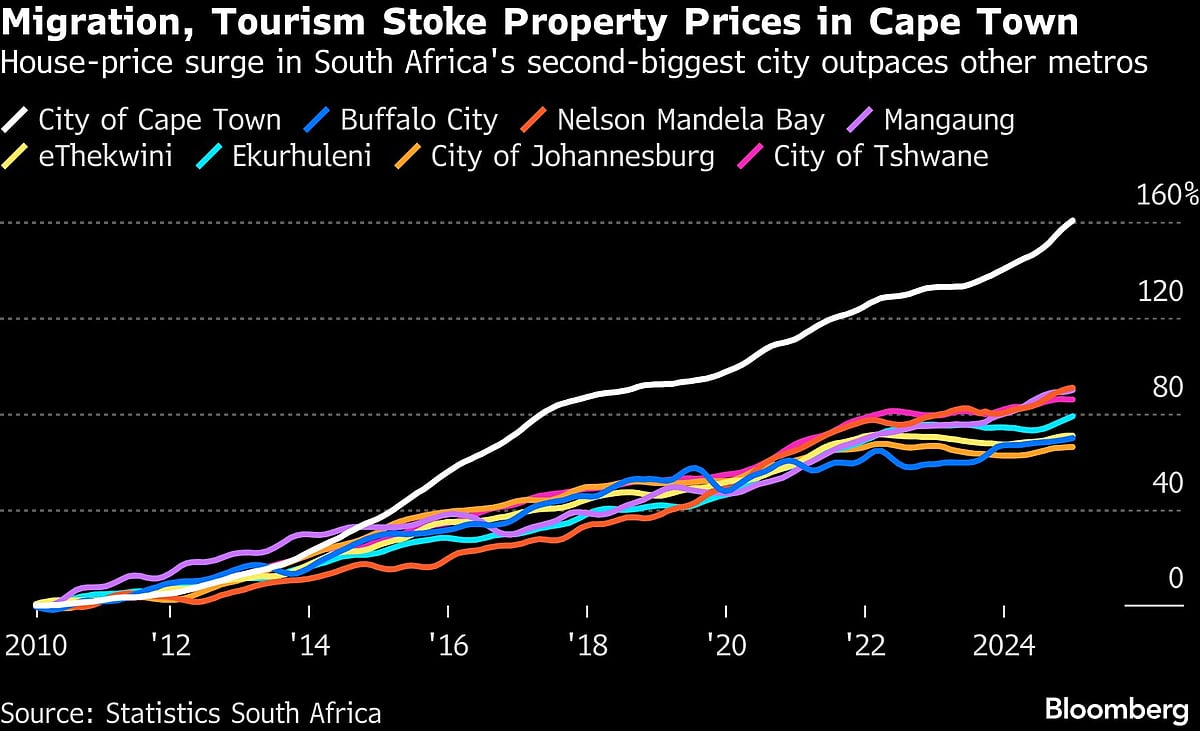
Still, the city ranks as the country’s best-run major metro and has attracted thousands of people in recent years, pushing property values sharply higher.
“This is one of the world’s great cities,” said Jason Lock, the Africa vice president for Nasdaq-listed outsourcing firm Concentrix Corp. The government “early on understood the potential and the power of this industry to attract foreign direct investment to create jobs, to build economic wealth for for city and for the communities.”
Call centers alone provide about 70,000 mostly entry-level jobs, about three-fifths of the national total for the industry. Over the next decade, the city plans to grow that number to 200,000 people, working across sectors like legal and accounting, according to Clayton Williams, the CEO of CapeBPO, a city-funded industry body. Many of those jobs are held by young women of color, the most marginalized demographic.

Officials are also positioning Cape Town as a premium location for conferences, film productions and luxury events. The city issued more than 3,000 permits for commercials, music videos and television series, in the last financial year. Shah Rukh Khan recently shot action and song sequences for a major Bollywood production.
Local authorities hope growth across industries will help the Western Cape economy expand by 49% to 1 trillion rand ($61.5 billion) by 2035, with Cape Town accounting for about three-quarters. That’s more ambitious than Gauteng, Johannesburg’s home province, which aims to grow output by a quarter to 2.18 trillion rand in the same period.
Johannesburg remains home to Africa’s largest stock exchange as well as major financial services and mining companies. It anchors a three-city conurbation that accounts for a quarter of South Africa’s population and a third of the national economy.
“We don’t have the mountain, we don’t have the sea, but we’ve got the 16.5 million people,” said Sthembiso Dlamini, the CEO of the Gauteng Growth and Development Agency. “We still have the heartbeat of the economy.”
Cape Town is isolated from other centers of population, but the pace of activity is hard to ignore.
Amazon’s new African headquarters teemed with construction vehicles on a recent summer afternoon. Workers moved materials between sites for new offices, cranes lifted glass panels into place, and landscapers tended an indigenous garden built on land sacred to South Africa’s San people, who trace their lineage back 100,000 years.
Across the road, new housing, offices, and retail space are being built. These facilities will cater to a growing population, which includes people relocating from other South African cities in a trend known locally as semigration.
About 100,000 families have moved to Cape Town in recent years, according to the mayor, based on consumer and address change data. They include Tamara, a self-employed mother, who relocated from Johannesburg in March with her husband and toddler. Her decision was driven in part by lifestyle.
“Being able to walk to a park, walk to the library, walk to the church and walk to the forest is amazing,” she said. “It is something we could not do in Kensington in Johannesburg, where gunshots were part of the neighborhood soundtrack.”
The contrast is not straightforward. While violent crime is more pervasive elsewhere in South Africa, Cape Town’s gang culture means it records a higher murder rate than Johannesburg. In one sign of the extent of such violence, as many as 26 people were killed on a recent weekend. City authorities say they’re constrained as law enforcement is typically the domain of the national government.
These crimes are prevalent in poorer areas, a divide that offers a further window into the extent of the disparity.
The middle-class suburb of Muizenberg with its sprinkling of historic homes is a short drive from the unkempt low-rise blocks of Mitchells Plain, once reserved for mixed-race South Africans, and then on to Khayelitsha — one of the largest slums in the world, according to Cities Alliance. That township borders a barren stretch of beach where wind whips sand off bare dunes across acres of corrugated iron shacks.
A few miles on, lie luxury wine estates.
“Cape Town remains one of the most spatially unequal cities in the world,” said Ndifuna Ukwazi, an activist and legal organization that advocates for affordable housing. “The legacy of apartheid planning continues to shape where people live, where jobs are located, and how long residents spend commuting.”
Whether the city’s model continues to concentrate opportunity in a narrow segment or delivers broad-based prosperity remains an open question. Officials defend budgets as “pro-poor,” highlighting service-delivery gains ranging from more efficient clinics to a functioning fire department, compared with Johannesburg’s shortage of trucks.
City authorities are now seeking to wrest some control of passenger rail, the port and policing from national government, moves that have generated optimism in some quarters.
“There’s a lot that can still go right,” said Izak Odendaal, the chief investment strategist at Cape Town-based Symmetry, an investment manager backed by Old Mutual. Authorities now need “to unlock the next level.”
© 2026 Bloomberg L.P.
Sign up for your early morning brew of the BizNews Insider to keep you up to speed with the content that matters. The newsletter will land in your inbox every morning on weekdays. Register here.
Support South Africa’s bastion of independent journalism, offering balanced insights on investments, business, and the political economy, by joining BizNews Premium. Register here.
If you prefer WhatsApp for updates, sign up to the BizNews channel here.
Leave a Reply