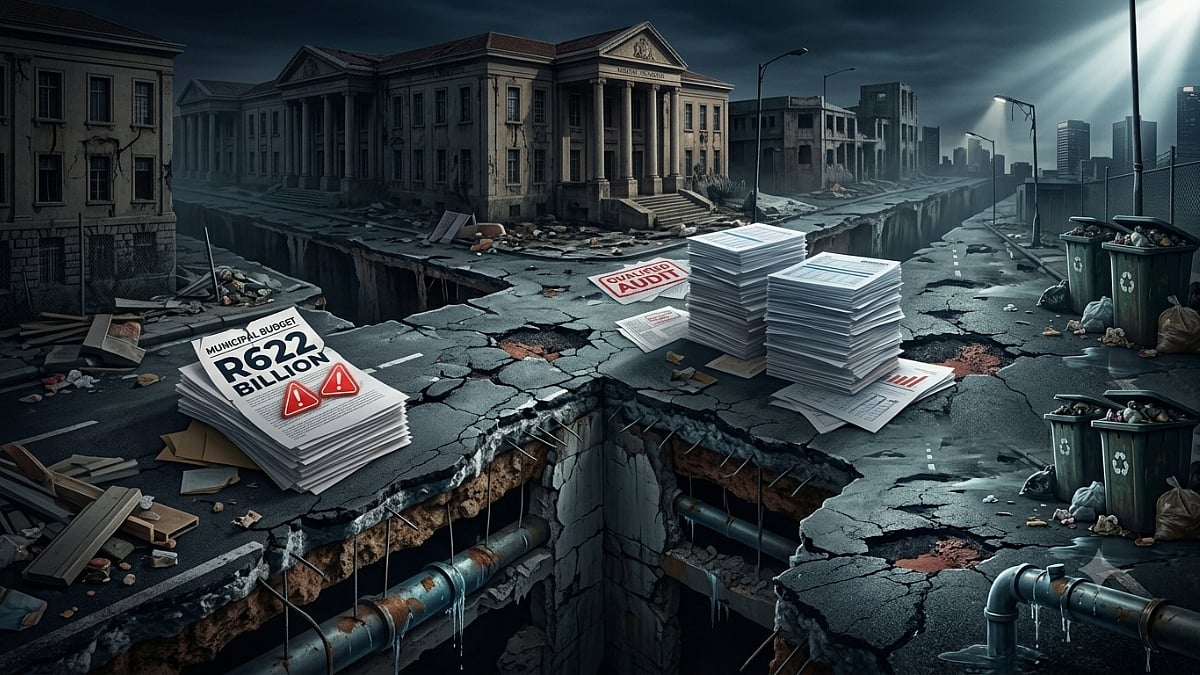
Annually, Auditor-General Tsakani Maluleke tables a report documenting the precise dimensions of local government failure. The latest one (2024-25) was released this morning. True to form, the numbers continued to worsen or stagnate. R145 billion in irregular expenditure since 2021, R36 billion last year. Only 39 of 257 municipalities with clean audits. Not a single metro. Maluleke’s office now has genuine enforcement powers — certificates of debt, referrals to the Hawks, remedial actions — and is using them. But the AG can audit, report, and refer. She cannot govern. That responsibility belongs to mayors, councils, and the political parties that put them there. And their reluctance to actually do anything reinforces this Republic of No Consequences.
By Alec Hogg
There is a scene I keep returning to when I think about Tsakani Maluleke’s work.
Imagine being the head of a company’s audit committee, year after year presenting the same findings to a board that nods politely, thanks you for your diligence, and then does precisely nothing. Now multiply that frustration by 257.
That, in essence, is the Auditor-General’s predicament.
Maluleke released 2024-25 local government reports this morning after tabling them in Parliament this week. The numbers are grimly familiar. Only 39 municipalities — around one in eight — achieved clean audits.
These outliers collectively administer just 8% of the total local government expenditure budget. Those which manage the rest of SA’s R622 billion municipal budget do so with varying degrees of incompetence, indifference, or outright dishonesty.
Warren Buffett reminds us that you only find out who’s been swimming naked when the tide goes out. SA’s municipal tide has been out for years. What the AG’s report reveals is not a sudden exposure but a chronic, structural undress — and almost nobody with the power to act seems particularly embarrassed.
Consider the scale of what Maluleke is up against.
Since 2021-22, municipalities and their entities have incurred irregular expenditure of R145 billion – R40 billion racked up in 2024-25 alone. Non-compliance with procurement and contract management legislation was responsible for 87% of the total. That is not administrative sloppiness. That is a procurement culture which has, in many municipalities, become the norm. Essentially, disciplines and rules are for others. Not for them.
The AG’s office does have real teeth now.
The material irregularity process — introduced with the 2018 amendments to the Public Audit Act — allows Maluleke to issue remedial actions and, where those are ignored, certificates of debt against accounting officers personally. It is a significant escalation of power for an institution that previously could only report and hope. And it is yielding some results: since 2019, 261 material irregularities (51%) have been resolved, with an estimated R1,7 billion recovered, in the process of being recovered, or prevented.
But R1,7 billion recovered against over R10 billion in losses from material irregularities alone tells you everything about the gap between the AG’s capacity and the scale of the rot. Maluleke has a scalpel. What local government requires is a hacksaw – surgery of an entirely different order.
The Metros illustrate this most starkly.
None of SA’s eight biggest cities achieved a clean audit. Together they serve 25 million people — about 40% of SA’s total population — and managed R336 billion, or 54% of the total local government budget.
Five of them now carry qualified audit opinions. The City of Johannesburg, which should be the economic engine of the continent, redressed to a qualified audit opinion, while material findings on compliance led to irregular expenditure of R74 billion across the four-year administration — three quarters of it from procurement failures.
Marcus Aurelius wrote that the impediment to action advances action; the obstacle becomes the way.
Maluleke appears to have taken that maxim to heart. Her office has referred matters to the Hawks, the SIU, the Public Protector, and various water and environment departments. She has used certificates of debt. She has reported the same municipalities for going-concern uncertainties for four consecutive years. She has named names.
And yet a total of 43 municipalities remained stuck in the “unqualified with findings” category between two and four consecutive years; 24 municipalities for five to nine years; and 20 municipalities for at least a decade.
The AG herself diagnoses the disease: accounting officers and political leaders misconstrue an unqualified opinion with findings as a good result, rather than the halfway house it actually is.
The real constraint is not legal power. It is political will — and that sits far beyond the AG’s remit. Maluleke can shine a torch into the darkness. She doers not have the power to force anyone to switch on the lights.
That task falls to citizens, to Parliament, and ultimately to voters. The AG has done her job. The question is whether those with the power to excise the rot will do theirs. Or even know what their job really is. Let’s hope that this time it really will be different. Roll on November 4.
Sign up for your early morning brew of the BizNews Insider to keep you up to speed with the content that matters. The newsletter will land in your inbox every morning on weekdays. Register here.
Support South Africa’s bastion of independent journalism, offering balanced insights on investments, business, and the political economy, by joining BizNews Premium. Register here.
If you prefer WhatsApp for updates, sign up to the BizNews channel here.
Leave a Reply