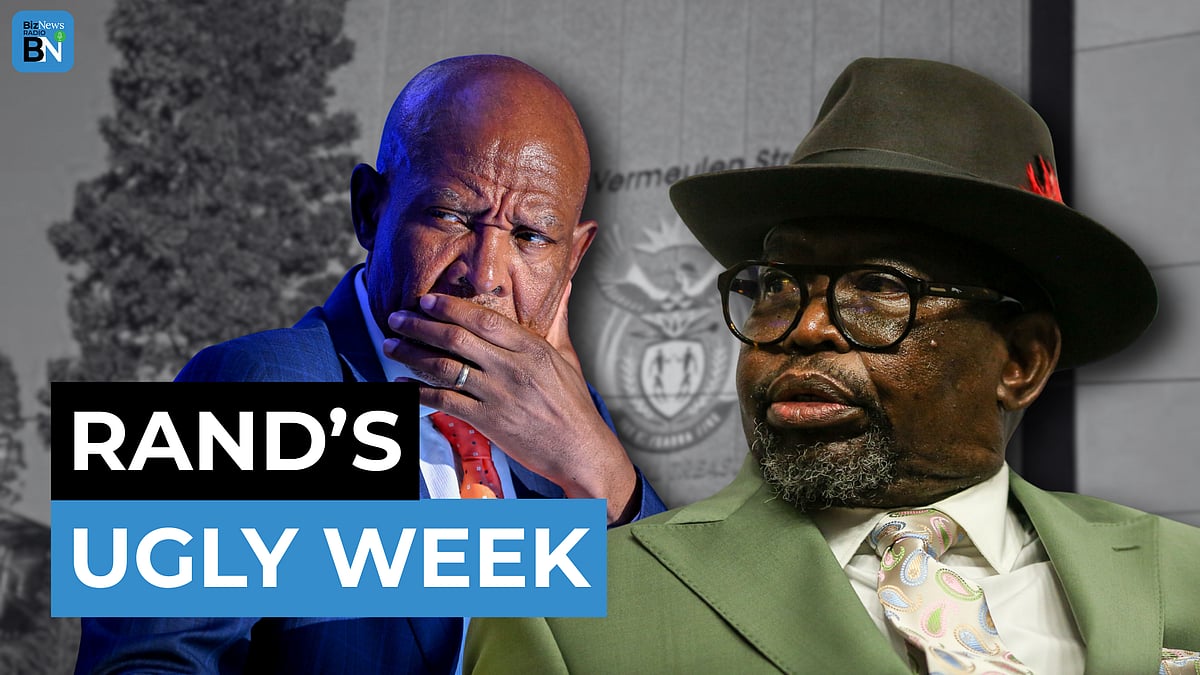
Treasury switched off the taps to 69 municipalities for doing nothing about corruption and mismanagement. Today it switched them back on anyway, days before its own deadline. Alec Hogg asks the obvious question nobody in government wants to answer. Plus: why last week’s Reserve Bank rate hold is already punishing the rand, a foundation funded by an arms dealer just published a survey putting China ahead of America in young Africans’ eyes, and on the JSE it’s a tale of two extremes: Valterra Platinum showering shareholders in cash while ArcelorMittal’s losses widen by the day. And the machine that prints the world’s most advanced chips just found out China isn’t waiting around.
Listen here
Episode breakdown
On Wednesday the 29th of July, I’m Alec Hogg, and welcome to your BizNews Edge.
Coming up today: the finance minister blinks on withholding money from delinquent municipalities. Or does he? A press release was issued just a few minutes ago, just before noon. We’ll have the insight on that in a moment.
There’s also a survey showing African youth now rate China above America, from a foundation whose funding you’ll want to know about. The Fed decides later today, and the Common Sense joins us, and the market, in calling last week’s South African Reserve Bank rate hold a mistake. And then results season continues on the JSE. HCI widens our Ricardo portfolio’s margin of safety, that’s in the annual report released today.
Valterra is raining cash on shareholders, and ArcelorMittal is going the other way entirely. And to close, internationally: Glencore, SK Hynix, and our Ricardo US Dollar Portfolio’s star performer ASML has dropped 11% in the past week.
Well, let’s get into that lead story. And it’s a question rather than a triumph. Finance Minister Enoch Godongwana announced today, in an online press conference, that Treasury will start releasing the withheld July equitable share transfers to municipalities from tomorrow. Basically, what’s happened here is that municipalities get a big chunk of cash every month from National Treasury. That’s the money that National Treasury budgets for in the national budget, and it is funded by us, the taxpayers. It comes from VAT, it comes from income taxes, and it comes from company taxes, mainly. There’s a little bit more on property transfers, et cetera, but that’s really where it comes from. So you and I are funding the worst municipality in South Africa, and every other one as well.
That’s the reality of it. Godongwana was trying to send a point. He was at pains, though, this morning to make one thing clear: this release of funds, after he’d actually stopped it, blocked it, to send a message to the errant and corrupt municipalities, is not based on a sudden conversion to competence and honesty by them. Treasury’s own assessment found material and continuing weaknesses. Material means sizeable. Failures to investigate misconduct, says. Incomplete investigations, disciplinary proceedings that were never instituted against crooks. Consequence management simply absent. Well, of the municipalities caught in this net, 28 did absolutely nothing at all in the past month, and yet they’re going to get their regular injection of taxpayer money, not tomorrow, on Friday. There we go.
The Republic of no consequences. The reason given by Treasury: the 30-day clock runs out on Monday, and Treasury won’t have poor communities carrying the costs of their officials’ failures. Maybe it’s time for poor communities to actually see what their officials are doing with the money that they, and others in the central part, the funders of the central part, are giving them.
Look, Treasury is in a tough position, so fair enough, genuinely difficult to balance those two issues. But the question many will be asking is the obvious one: if the money flows regardless, what was the point of the exercise? Godongwana promises us that there will be stricter conditions for December. We shall see.
On to the African Youth Survey, released this morning, and a number that should make Washington wince. 95% of young Africans now see China positively. For the United States, it’s 85%. So, 10 percentage points’ difference. Essentially, they say China has a better influence, it’s doing better for Africa than the United States is.
The US, in fact, is now behind Britain, the EU, India and Germany. South Africa is the outlier in all of this. There were 16 African countries surveyed. Our young people believe, 58% of them anyway, that America is positive. But that’s the lowest of all the African countries surveyed. Remember, the average for those 17 countries, 16 plus us, is 85%, and our guys clock in at 58% positive.
Clearly, the battle between Cyril Ramaphosa and the ambush in the White House by the US president, or the perceived ambush anyway, didn’t go down well with our young people. But the source of all of this matters, and we’ll say so plainly: this is the Ichikowitz Family Foundation survey. This foundation is chaired and funded by Ivor Ichikowitz, whose Paramount Group is a major private arms manufacturer selling lots of its arms into the continent. A man with that clientele has an obvious stake in how Africa’s great power alignments get read. It’s worth holding in mind alongside the data, which is, on any reading, striking. I’ve been promised an interview with Ichikowitz. Let’s see. The arms maker is hardly what you’d call media-friendly.
This brings us to interest rates. The Federal Reserve concludes its meeting today, and the expectation is for a fourth straight hold, though, as Bloomberg reported this morning, some market participants are braced for a surprise hike as patience with inflation is wearing thin there. New chairman Kevin Warsh has committed to bringing inflation down, without saying how far he’ll go.
Now, if that were to happen, if the Americans were to raise interest rates, it would pile more pressure on the South African rand. And we’ve seen that the rand has come under enormous pressure because of what happened last week at our own interest rate setting decision at the South African Reserve Bank. And on that front, the Common Sense editorial board, led by Dr Frans Cronjé, has landed squarely where we did last week.
The Reserve Bank’s decision to hold the repo rate at 7% against near-universal expectations of a hike was a mistake. The rand shed almost 3% within hours of that decision. Inflation, measured here in South Africa by the consumer price index, hit 5%, a two-year high, in June. And that’s against SARB’s 3% target. So what are you doing? If you’ve got a target of 3%, you’re sitting 60% higher, yeah, that’s what 5% on 3% is, and yet you’re not using the tools at your disposal to attack it. As Cronjé’s team put it: the market will do to the economy what the bank refuses to do with rates, and it’ll do it punitively.
To the JSE now, and good news for those holding Hosken Consolidated Investments, HCI, which is one of the better performers in our Ricardo portfolio. HCI’s annual report was released to shareholders this morning. It showed revenue up to 24 billion rand, and EBITDA up again. That’s the profit, what we used to call operating profit, but it’s before depreciation and amortisation, so it actually gives you a better feel of the cash itself. HCI’s gaming, hotels, transport and media businesses were all growing in the past year. Headline earnings fell, but that’s really because of a base effect: last year carried a large one-off investment surplus. What matters in a company like this is the net asset value, and that rose again. And the share has been trading at roughly half its underlying worth, what we call its intrinsic value. That’s the number you need to look at to say whether the share is cheap or expensive. And if it gets close to intrinsic value, be careful, maybe it’s time to be switching to something that’s cheaper in relative terms. We have a 40% margin of safety now on the current share price, and the market noticed that this is surely too high. The shares were up on the day on well above the usual volume.
And then, also on the corporate front, on the Stock Exchange News Service this morning, Valterra Platinum, that’s the former Anglo Platinum, released its interim results today, and they’re spectacular. Headline earnings up more than 1,600%. Revenue almost doubled. Free cash flow moved from around four and a half billion rand negative, in other words, that’s what went out, to roughly 25 billion rand positive. What a huge turnaround, a 30 billion rand turnaround. The balance sheet is now in a net cash position, sitting on close to 24 billion rand in the bank. But the real story is what they did with all that money. An interim dividend totalling 57 rand a share has been declared. That’s a 70% payout of their profit, against a policy of 40%. That’s 15 billion rand of that cash reserve going straight back to shareholders. The market rewarded the stock, with the share price up on the news.
And the mirror image, on the very same morning, at ArcelorMittal South Africa: its trading statement warns that headline losses for the first half of this year widened by as much as 51%, to around R1.30 a share. That’s more than the current share price, just in losses, in just six months.
Weak domestic demand, high energy and rail tariffs, cheap imports, the same structural vice we’ve discussed here before. The shares fell on the news, from a very depressed level. Note the contrast with Valterra: there you’ve got a South African producer handing back 15 billion rand to shareholders. ArcelorMittal is deepening its losses, while the Newcastle plant’s fate is still hanging on the IDC rescue deal that we hear come and go. We might hear more tomorrow from results, from chief executive Kobus Verster and his team.
Well, now to the global scene, and our partners at Bloomberg have got two stories that tell you a great deal about where markets are right now. Glencore, listed on the JSE and a company that we know very well at BizNews because of the huge South African contingent who are there, not only the leaders but throughout that organisation, is having a near-record year. But SK Hynix, recently listed on Wall Street, was punished despite record profits. Here are our partners at Bloomberg, just a few minutes ago:
Glencore says its trading team made about $3.3 billion in profit during the first half of the year, putting the company on course for one of its best-ever years. Based on its first-half performance, Glencore is within touching distance of the top end of its annual earnings goal, which is set at $3.5 billion. So 2026 could see Glencore beat its record haul of $6.4 billion, which was back in 2022. Commodity trading houses have reaped big profits as the conflict in the Middle East has dislocated energy markets, and the AI boom has fuelled metal prices. Glencore shares rose as much as 4%, taking its gains to around 30% this year.
Shares in South Korean chip giant SK Hynix have plunged, despite reporting record profits that rose more than 550% from a year ago. Record profit margins and plans for $31 billion of capital expenditure weren’t enough to meet sky-high expectations for one of the AI industry’s linchpins. Here’s Bloomberg’s markets reporter, Anthony Stevens:
“This speaks to where expectations are, right? Like, you have a record OP, it’s a 557% jump, they’re talking about 80% plus margins, 83. You have an ADR that went into the results with 20% plus premium. And that speaks to the problem here: positioning and expectations meeting very high standards is becoming very difficult.”
Anthony Stevens was speaking as SK Hynix led another day of sell-offs in chip stocks in Asia. South Korea’s KOSPI index has now seen one of the most volatile quarters in history for a major market.
So, from the results, to what we’re expecting from the Federal Reserve. We’re expecting to see a hold in terms of interest rates when the central bank concludes its two-day meeting today. But market participants are eyeing the possibility of a surprise hike as patience with inflation wears thin. Meredith Whitney, the CEO of Meredith Whitney Advisory, isn’t, though, expecting a move:
“I think they stay hold, and they’ll probably still have this tough guy language, this hawkish language, that gives them wiggle room. I think that putting these people on these special task forces buys Chairman Warsh time.”
Meredith Whitney speaking to Bloomberg. New Fed chair Kevin Warsh has said that he is committed to lowering inflation, but hasn’t indicated whether he supports increasing interest rates to do so. The Fed will release a post-meeting statement at 2pm today in Washington, at 7pm London time. Warsh is scheduled to hold his second post-meeting press conference 30 minutes later.
And that SK Hynix reaction leads us straight to our last story for today, because it’s the same disease, and it’s caught our Ricardo US Dollar Portfolio’s star performer. The share price of ASML, the Dutch company that makes the machines that print the world’s most advanced chips, has fallen 11% in the last week. The trigger was a report that an unnamed Chinese firm is close to producing rival machines, perhaps 20 a year by 2027. That’s small against ASML, who produce around 130 to 150 of these machines annually, but are looking to grow that by 30% in the year ahead. But let’s keep perspective: ASML holds 90% of this market, and a total monopoly at the sophisticated end, so right at the top, no one comes close. Bloomberg Intelligence reckons China remains seven to ten years from matching that technology.
As Bloomberg’s Lionel Laurent argues, in an article that’s on BizNews today, these machines are like jet engines: decades of engineering, an ecosystem of suppliers, not something you can reverse-engineer in a hurry, even if you are Chinese and have got a good record of doing that. But two things are worth taking seriously. It’s now a question of when, not if, with perhaps a fifth of ASML’s sales at stake. And ironically, the American export controls designed to contain China have taught Beijing precisely what it needed to learn to do without ASML altogether. As one professor told Laurent, that’s the classic problem with technology wars: they work for a while, but they teach the adversary exactly what it needs to become independent of you.
Counterintuitive, isn’t it? Well, that’s the BizNews Edge for today, giving you the edge, I believe, not just for the next few hours, but part of the whole lifelong learning journey. I’m Alec Hogg. For more, head to biznews.com. See you tomorrow.
Leave a Reply