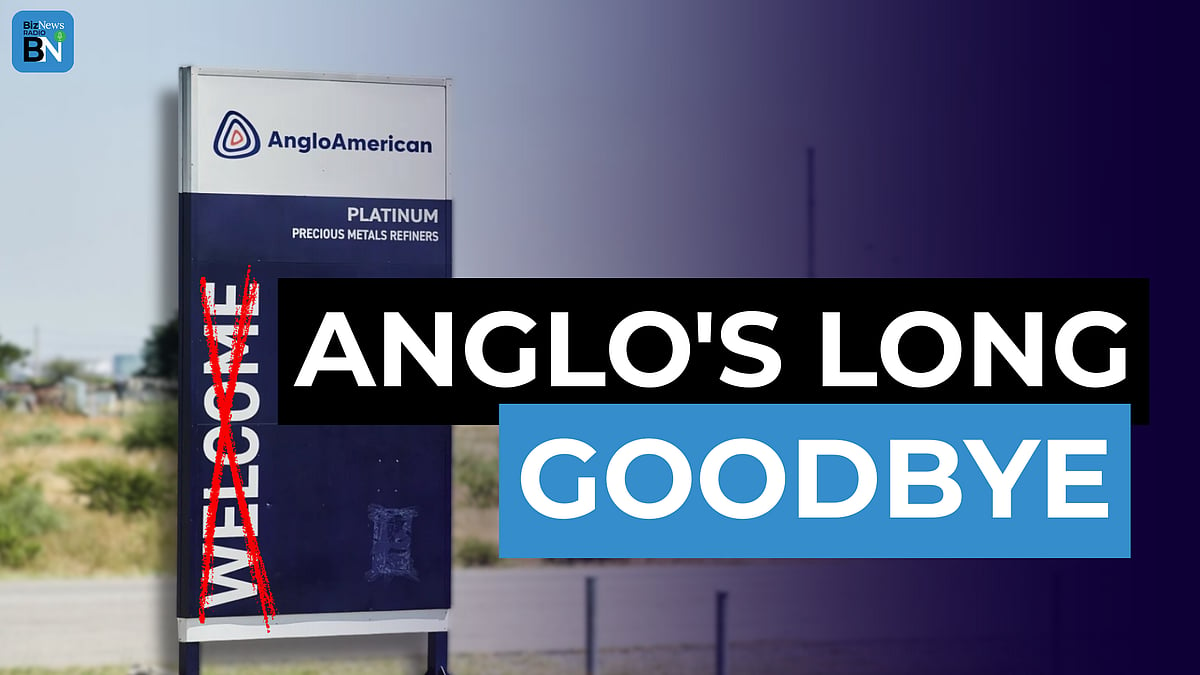
Anglo American just posted the kind of interim numbers investors dream of. But look past the headline and the real story is a 109-year-old Johannesburg company quietly finishing its exit from South Africa, with its head office bound for Vancouver and De Beers set to go for a fraction of what Anglo once paid the Oppenheimers. Meanwhile Old Mutual’s new survey shows more than half of working South Africans are now gambling just to get through the month, and a growing share are ending up worse off for it. Add grim ArcelorMittal numbers, a Reinet buyback, a Woolworths update that’s more warning than celebration, a new Fed chair rattling global bond markets, and record-breaking results from Samsung, Microsoft and Meta with Satya Nadella and Mark Zuckerberg both making their case for AI, and you’ve got a lot to get through. BizNews editor Alec Hogg unpacks all of it.
Listen here
Episode breakdown
Alec Hogg: Welcome to BizNews Edge. It’s Thursday, the 30th of July. I’m Alec Hogg.
Alec Hogg: Anglo American’s interims landed on SENS this morning with genuinely strong numbers. But look past the headline and you’ll see the real story: this company keeps getting smaller in South Africa. We’ll unpack that, and then add to another worrying trend: Old Mutual has just released a survey showing that more than half of working South Africans are gambling just to make ends meet.
Alec Hogg: Then also landed this morning: ArcelorMittal’s interims, Reinet’s big buyback has been wrapped up, Woolworths posted a cautious trading update which the market liked, and global bond markets are in turmoil after the Fed’s decision overnight. And we close off the show today by bringing you directly from Satya Nadella, he’s the CEO of Microsoft, and Mark Zuckerberg, his counterpart at Meta.
Alec Hogg: On whether they see AI adoption sweeping through, Microsoft tied to corporates, Meta’s side, consumers. Let’s get into it.
Alec Hogg: Well, we start today’s Edge with Anglo American, because these interim numbers tell two stories at once. On the surface, it’s an excellent set of numbers. Underlying earnings are up 35%, free cash flow, this is what investors like most, close to 150% higher, and the dividend very nearly tripled. Copper is doing the heavy lifting. The market liked what it saw.
Alec Hogg: But as we reported on BizNews.com this morning, the more interesting story is what Anglo is walking away from: confirmed today, the sale of its steelmaking coal business, and advanced talks to offload its 85% stake in De Beers at a fraction, roughly a tenth of what it paid the Oppenheimer family for control around a decade ago.
Alec Hogg: And the pending Teck merger, which shifts the centre of gravity to the Americas, Teck is based in Canada, and the new head office will be in Vancouver. You’re watching a 109-year-old Johannesburg company, 44 Main Street as we knew it for its headquarters, complete its slow-motion exit from the country that built it.
Alec Hogg: Kumba Iron Ore is very much all that’s really left standing here.
Alec Hogg: If that’s not worrying enough for policymakers, or people in Pretoria who actually care about what’s going on in the country, and if you can’t see the deterioration in the mining sector in those Anglo results, then I don’t know what it’s going to take to do it. But here’s something from Old Mutual. It’s just published its Savings and Investment Monitor, it does it annually.
Alec Hogg: This is for 2026, and in it, it found that over half of working South Africans gamble, mostly on sport, and 42% of them are doing it specifically hoping to cover monthly expenses or pay down debt. Here’s the number that jumped out at me: the share of gamblers who say they’ve actually landed in financial difficulty because of gambling has nearly doubled in a single year.
Alec Hogg: 12% in 2025, 22% today. So half the workers gamble, and a fifth of those who gamble say because of it, they’re in financial difficulty. Old Mutual’s Vuyokazi Mabude put it simply at this week’s briefing. She said people are, in her words, looking for ways to make extra money, and when it doesn’t work out, they end up worse than before.
Alec Hogg: It fits a bigger picture that Old Mutual paints of a two-speed nation. Wealthier South Africans growing more confident, lower earners are sinking deeper into debt, loan shark borrowing, and now gambling.
Alec Hogg: A late-breaking one just in: this morning, ArcelorMittal South Africa’s interims to June were released. They make for grim reading. Revenue slumped 30% to just over 12 billion rand, and the headline loss widened to almost 1.5 billion rand for six months. Net borrowings nearly doubled. The Newcastle long steel plant remained mothballed with no restart pencilled in before 2027 at the earliest.
Alec Hogg: AMSA, as they call themselves in this country, is instead chasing steel revenue from data centres and industrial hubs to cover the care and maintenance bill in Newcastle. The one thing propping up the share price right now is the continued confirmation of advanced talks between ArcelorMittal and the IDC on a possible rescue transaction for the KwaZulu-Natal plant. Cheap Chinese steel imports and a firmer rand aren’t helping; the stock fell a further 2.5% after the publication of the results.
Alec Hogg: Not surprisingly, because they make, as mentioned earlier, pretty grim reading. But the speculators still think there’s going to be a deal with the IDC, and that pulled the price back to where it’s been, pretty much, for the past year. And that’s where it trades right now. The real question, though, is will Pretoria step in before it’s too late?
Alec Hogg: And now Reinet, a company in the Rupert Empire, added to the business portfolio on Tuesday, and it’s today announced that it’s concluded its share buyback programme. The Luxembourg-listed investment vehicle, home to 600 rand a share in cash, all in euros, after it sold its shares in its two major assets, the Pension Insurance Corporation and British American Tobacco.
Alec Hogg: It spent just over a billion rand, buying back 2.5 million of its own shares in the past five weeks, snapping up the final tranche at around 448 rand apiece. Remember, the company’s got 600 rand a share in cash, so it certainly can see value there. Problem is, it has to go back to shareholders and get further sign-off for a bigger share buyback programme before it can come in.
Alec Hogg: And that’s about as aggressive as share buybacks can get, because it tells you that management believes Reinet’s assets are worth considerably more than the market is paying. It doesn’t take a rocket scientist to work that one out. However, the share buyback is over. Share buybacks always give a nice underpin to a share price. Don’t be surprised if the share price eases back a touch now that the corporate buyer, i.e. the company itself, has stepped out of the market.
Alec Hogg: Top-end retailer Woolworths gave us a trading update that’s best described as solid but sobering. That came out this morning on SENS, where it says full-year headline earnings, to be released early next month, should rise in the mid-single digits, and the food division, still the group’s engine room, grew nicely, with online sales close to 20% there.
Alec Hogg: Country Road in Australia is back in profit after some hard cost-cutting. The market really liked that part. But the second half told a very different story to the first. Sales growth slowed sharply in the second six months of the financial year, hit by higher fuel prices, higher interest rates, and generally a tougher environment for consumers.
Alec Hogg: Shoppers were squeezed in both South Africa and Australia, forcing Woolworths to clear excess fashion stock at a discount. I know, I bought a couple of jerseys at a pretty good price, thank you Woolies. Bad debts on the group’s store cards are also creeping higher, another reflection of a hard-pressed consumer. The market liked the overall context of the trading update though, the share price gaining 3.5% this morning on steady buying.
Alec Hogg: Woolworths has long been the JSE retail benchmark for execution, and this update shows that the discipline is still there. Food keeps growing its market share, Australia has been fixed, and that came as a great relief. But when the group that manages its business better than almost anyone else in this country is telling you the second half got harder.
Alec Hogg: Well, that’s a signal about the state of the South African, and I suppose to a lesser extent the Australian, consumer, not just about one company’s fashion racks.
Alec Hogg: Onto the global market now. The financial world pretty much stops when we have a Monetary Policy Committee meeting in the United States at the Federal Reserve, especially now that we’ve got a brand new Fed chair, Kevin Warsh. Well, unfortunately, what he said last night did not land well, and the global bond market has been in a spin ever since.
Alec Hogg (reading Bloomberg News wire copy): A global bond rout continues after the Fed held interest rates at their meeting yesterday. The two-year Treasury yield climbed three basis points on Thursday to 5.23%, the highest since 2007, extending an 11 basis point jump following the Fed decision.
Alec Hogg (reading Bloomberg News wire copy): Investors are now questioning whether the Federal Reserve is serious about tackling inflation, despite Kevin Warsh’s hawkish rhetoric. For some households, businesses and market professionals, five years of high inflation have left a mistaken impression that’s hard to shake: that the Fed’s implicit inflation target was somehow above 2%. Let me reiterate, there is no soft inflation target. However, investors appeared unconvinced by Warsh’s words, sending two-year yields sharply higher as markets wagered the Fed was only delaying an inevitable rate rise.
Alec Hogg (reading Bloomberg News wire copy): Within hours of his press conference, JPMorgan brought forward its forecast for the next hike to December. Markets are now pricing a 65% chance of a rate rise at the next Fed meeting in September. The US military says it has launched a powerful response to Iran’s attempted missile attack on American forces in the Middle East. The US says it struck dozens of Iranian targets, including command centres, missile and drone facilities, and coastal defence sites as well.
Alec Hogg (reading Bloomberg News wire copy): The strikes came less than 24 hours after Tehran fired ballistic missiles at a US base in Jordan, ending a brief pause in hostilities. Meanwhile, US Energy Secretary Chris Wright says that oil continues to flow out of the Gulf. A seven-day trailing average right now out of the Arabian Gulf region is 13 million barrels a day, about half of that flowing through the Strait and half through bypass pipelines.
Alec Hogg (reading Bloomberg News wire copy): So we’re about two-thirds of the way back to delivery of oil out of the Arabian Gulf region compared with before the conflict started. His comments come as Qatar sent its first shipment of LNG through the Strait of Hormuz in more than three weeks, offering a sign that energy supplies are beginning to recover. Despite the renewed fighting, Samsung’s chip business has reported a jump of nearly 1,800% in second quarter profits as it gains ground in the AI memory race.
Alec Hogg (reading Bloomberg News wire copy): The massive increase lifted operating profit at the division to an analyst-beating $62 billion. Here is Bloomberg’s Seoul bureau chief, Kat Barton.
Kat Barton (Bloomberg Seoul Bureau Chief): It was an absolutely historic quarter for them. Record profits for their semiconductor division, obviously their mobile phones and their other electronics didn’t do quite so well, they actually tipped into a loss. But the semiconductors are doing so outlandishly well that it’s carrying the whole company at this stage.
Alec Hogg: That was Kat Barton, their Seoul bureau chief, speaking as Samsung’s shares moved sharply on the results as investors questioned whether the AI boom can continue to justify the sector’s massive spending. The results come just a day after rival SK Hynix also reported record profits that still fell short of investors’ lofty expectations.
Alec Hogg: That’s the story, really, in investment markets around the world. The point that was made at the end there: on the one hand you’re getting these fabulous results coming out of companies, but on the other, investors, or the big money, are saying, hang on, this can’t continue. To us, like the companies themselves say, this AI boom is playing us a way.
Alec Hogg: It’s bigger than anything we’ve ever seen before. And investors are saying, well, it might be, but history says heavy spenders funding a boom like this are the ones who end up losing. Let’s get on to the two big tech results that were released last night on Wall Street. Starting off with Microsoft, whose full-year revenue passed $331 billion, up 18% on the previous 12 months.
Alec Hogg: That’s near-exponential growth for a very mature company, as Azure alone crossed the $100 billion mark, growing over 40%. That’s its alternative to Amazon Web Services and to Google Cloud. Paid seats for the Microsoft 365 Copilot tool surged past 30 million, that’s AI with corporate uptake doubling quarter on quarter. Capital spending, though, remains enormous, 41 billion dollars in the quarter alone.
Alec Hogg: So you can see you’ve got these two parts: on the one side, the existing business is booming, on the other side, the money is being spent hand over fist on the future, in capital investments. Satya Nadella remained very upbeat through last night’s investor call, and he actually gave an insight into what he thinks the corporate commitment is going to be driven by. Let’s have a listen.
Satya Nadella (CEO, Microsoft): At the end of the day, the goal is to have the firm be in control of their own destiny, done through what I describe as building the human capital and the token capital. Right? So at the end of the day, if a firm is a learning machine, they need their own learning machine. And that’s really the goal, and the models are an input, not some extraction of the knowledge of the enterprise.
Satya Nadella (CEO, Microsoft): But in some sense, you have to, at the end of the day, every firm is going to evaluate who are the providers, who are helping them with their outcomes and then knowledge creation. I think that is now fairly clear, and it’s going to become clearer by the day. This is not going to be about, you know, come in and take all my knowledge and benefit yourself.
Satya Nadella (CEO, Microsoft): Whereas I am not getting anything out of it. And that’s exactly where Microsoft is focusing its attention, to help the corporates, not to take from them.
Alec Hogg: That’s the story anyway. Meta, on the other hand, had numbers which were every bit as striking, also released last night. Quarterly revenue came in at $60.8 billion, up 28%, and net income was nearly $16 billion.
Alec Hogg: Mark Zuckerberg’s family of apps, Facebook, Instagram, WhatsApp and Threads, now reaches over 3.6 billion people every day, almost half the people on the planet. And full-year capital spending, though, has been lifted again to as much as $145 billion, most of it going into AI infrastructure and data centres. So yeah, you see the tension once again: great numbers from the existing businesses.
Alec Hogg: But that money is being spent. And then more so on the future. Is it going to win or is it not going to do so? Zuckerberg is very optimistic about consumers becoming more and more enabled with artificial intelligence. Here’s the part from his investor call last night that actually resonates best.
Mark Zuckerberg (CEO, Meta): One of the bets here that we’re making is that we think that consumer personal agents is going to end up being an extremely important and massive market.
Mark Zuckerberg (CEO, Meta): I think that it’s extremely unlikely, if you look out five years from now, for example, or whatever period of time you want, that you don’t have billions of people with a personal agent that understands your goals, and that it’s just working on your behalf 24/7 to achieve your goals, whatever the domain is that you care about, whether it’s helping you with your health or your hobbies or your personal finances or your productivity and running your home better, or improving and enhancing your relationships, helping with your career, helping, like, just all these different things.
Mark Zuckerberg (CEO, Meta): This is a very, very deep set of use cases.
Alec Hogg: So do we believe the markets, do we believe history, or do we believe the chief executives of the companies who’ve got insight into the demand and where they see it all going? Well, it’s very easy: you make your call, you take your chances, and you make your investment. What we did this week was we sold Meta.
Alec Hogg: And not a bad idea, as it turns out, to look at it today, because the share price is down 7% in the after-market on those results. And we bought into a nuclear power producer that’s going to be sending electricity to these data centres, a little bit like the pick-and-shovel providers for a gold boom. Are we going to be right?
Alec Hogg: Is Meta going to make us eat our words? Who knows? But in markets you have to have a view, and that’s ours. And that’s BizNews Edge for today. Thank you for spending this time with me. For more on all these stories, head to BizNews.com, where you’ll find the full versions of everything that we’ve covered today. I’m Alec Hogg.
Alec Hogg: Until next time, cheerio.
Leave a Reply