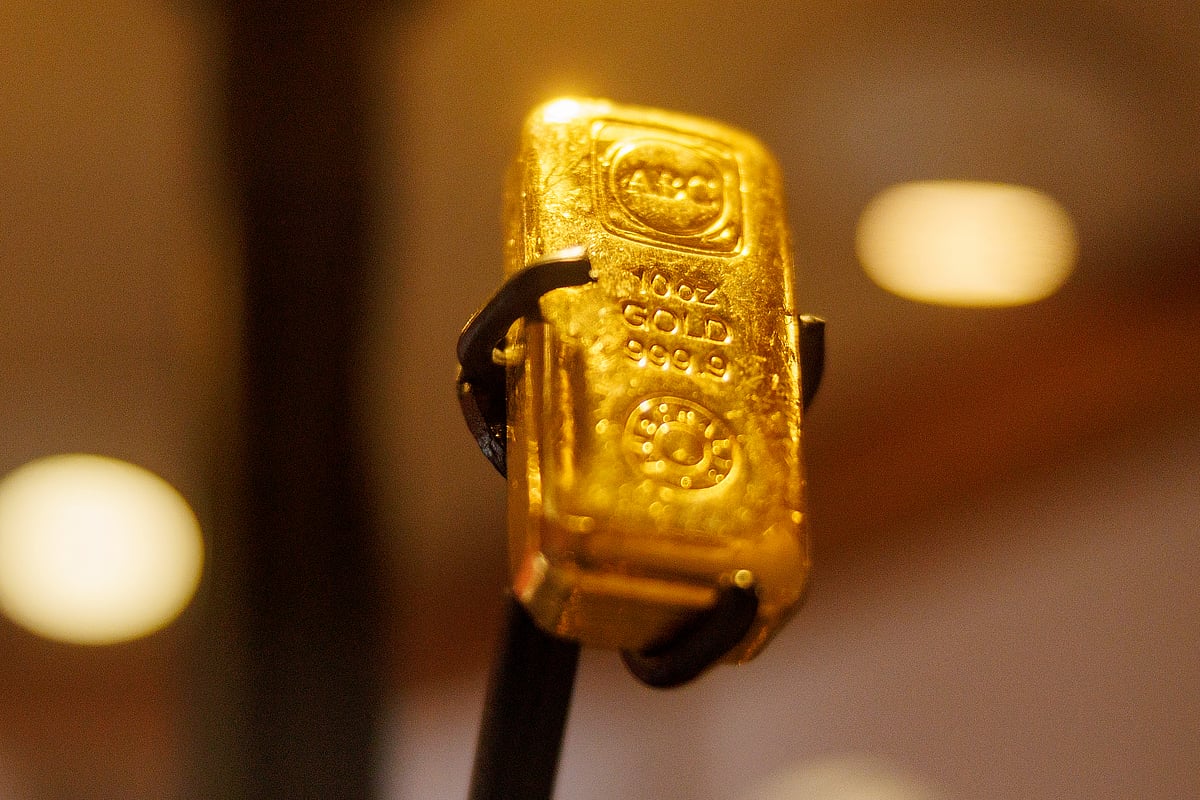
Gold’s richest run ever handed South Africa’s mining majors record windfalls — AngloGold’s earnings nearly tripled to $2.7bn, Gold Fields’ to $3.57bn. In Part II of his Gold Papers series, Dr Duarte da Silva tracks where that cash actually went: Harmony spent $1.01bn on Australian copper rather than the uranium already sitting in its own tailings; AngloGold relocated its listing and domicile to New York and London; Gold Fields now runs just one South African mine. Building on Part I’s case that the Witwatersrand is far from exhausted, da Silva argues the reef didn’t run out of metal — its owners ran out of interest.
By Dr Duarte da Silva, Capital Markets Strategist • Managing Director, Northbound Processing • Germiston, 2026
US$1.01bn — Harmony’s Australian copper mine, bought at the top of the gold market
London, 2023 — where AngloGold Ashanti moved its home — off the reef that made it
1 of 9 — Gold Fields’ producing mines still inside South Africa
EXHIBIT A · THE WINDFALL
I. The best year gold ever had, and where the money went
Gold has never been worth more. It crossed three thousand dollars in early 2025, touched roughly five and a half thousand at the end of January 2026, and trades above four thousand as I write — a level that would have been dismissed as fantasy a decade ago. For the companies that mine it, this is the richest environment the industry has known, and their results show it. AngloGold Ashanti turned headline earnings of under a billion dollars in 2024 into two point seven billion in 2025; Gold Fields lifted profit from one and a quarter billion to three and a half. Market values doubled. The two South African majors added tens of billions of dollars of capitalisation in a single year, on the back of a metal that has done nothing but climb.
So the question that matters is not whether the gold houses are making money. It is what they are doing with it. A windfall of this size is a decision waiting to be made — return it, reinvest it, or redeploy it — and the decision the South African majors have made is written into every deal they have signed. The money is leaving. It is crossing oceans, into copper in Australia, into gold in Nevada and Quebec, into a corporate home in London, rather than flowing back into the reef that produced it. At the richest moment the industry has ever seen, the houses born on the Witwatersrand are deploying their windfall as far from the Witwatersrand as they can.

EXHIBIT B · THE PATTERN
II. Gold funds it, copper justifies it
The clearest expression of the flight is the copper deal. Across the sector, gold miners are using record cash to buy copper, and the cheques keep getting larger. Evolution Mining paid four hundred and seventy-five million dollars for a majority of Northparkes in 2023. Harmony paid a little over a billion for the CSA mine in 2025. Eldorado Gold spent close to three billion, in shares, to take Foran and its McIlvenna Bay project in 2026. The logic recited each time is identical: gold throws off the cash, and copper — scarce, structurally short, essential to the electrical build-out — supplies the justification. Gold funds it; copper justifies it.
The pattern is real and it is global, so I will not pretend it is a South African invention. What matters for this paper is the South African name in the middle of it. Harmony Gold is the largest gold producer in the country by volume, a company whose entire operating history runs through the Free State and the West Rand. When Harmony decided to write the largest cheque in its modern history, it did not spend it on the ground beneath its own plants. It spent it on a copper mine in New South Wales.

III. Harmony buys the second metal abroad
There is a particular irony in Harmony’s choice, and Part I of this paper is what makes it visible. Harmony already owns a second metal, at home, for almost nothing. The uranium in its Vaal River tailings and the Moab Khotsong reef is a re-rated, strategically scarce by-product sitting in rock the company already processes for gold — a second revenue stream it barely troubles to report. Part I set out the case in full: the Witwatersrand carries two metals, and the second has quadrupled in price. Harmony is the operator best placed in the world to prove that case, because it runs the only integrated gold-and-uranium circuit still turning.
Instead it reached across the Indian Ocean for a different second metal. The CSA mine is a fine asset — high-grade, long-life, in a stable jurisdiction — and the strategic account of it is coherent: copper diversifies the revenue base and dilutes the company’s exposure to the gold price. I will give that argument its due further on. The point here is one of revealed priority. Offered a re-rated second metal in its own dumps and a re-rated second metal eleven thousand kilometres away, the largest gold house in South Africa chose the one it had to buy over the one it already owned. The capital went where the company’s imagination went, and its imagination went offshore.
IV. AngloGold leaves the country
Harmony at least still mines at home. The other two majors have spent two decades arranging not to. AngloGold Ashanti — assembled out of the Anglo American gold empire, the direct corporate heir of the Witwatersrand — no longer keeps its home in South Africa at all. In 2023 it moved its primary listing to New York and its domicile to London, in search of deeper pools of capital, entry to indices its Johannesburg listing could not reach, and a rating closer to its North American peers. Its growth capital now points at Nevada, where the Arthur project carries close to five million ounces of reserves, and at Egypt, where a half-share of the Sukari mine supplied most of last year’s production increase. The company still operates across Africa. It is no longer, in any corporate sense, South African.
That the strategy has paid the company is not in dispute. AngloGold’s market value has more than doubled, and it now ranks as the largest listed company in Africa by capitalisation — its own kind of irony for a firm that has just finished leaving. The turnaround is real. What it demonstrates, for this paper, is the strength of the current pulling capital off the reef. The most direct heir of Witwatersrand gold looked at the basin that made it and concluded that its future lay in being domiciled anywhere else.
EXHIBIT C · THE VERDICT TABLE
V. Gold Fields mines everywhere but home
Gold Fields completes the picture. A company that took its name from the South African fields now runs a single mine inside the country — South Deep, the last one — while six of its nine producing operations sit outside Africa entirely. Its flagship growth project is Windfall, in Quebec, whose budget has more than doubled without shaking the company’s commitment to it; the chief executive still calls it a good deal. Its Ghanaian position is shrinking, with the Damang lease reverting to the state in 2026. The direction is plain, and management does not hide it: the future of Gold Fields is being built on other continents, and the South African mine is a legacy holding rather than a growth one.
Set the three houses side by side and the shape of the decade is unmistakable. Every one of them is deploying its record windfall away from the basin that produced its gold, and only the operators the majors long ago left behind are putting capital back into the reef.

VI. The case for leaving
Set against all this is a real argument, and I will make it as strongly as its advocates do, because a verdict is worth nothing if it only answers the weak version. South African gold mining is hard, and the difficulty is not imagined. The remaining reef is deep — the deepest workings on earth sit under this basin — which makes it hot, dangerous and expensive to reach. Power supply has been unreliable for fifteen years. The regulatory regime shifts, and the security of tenure that capital requires has not always been there. Against that, a shallow open pit in Nevada or a long-life copper mine in a stable Australian jurisdiction is a lower-risk ounce, and lower-risk ounces earn higher multiples. A board that moves capital from deep, contested South African rock to shallow, secure foreign rock is not being disloyal. It is doing exactly what boards are appointed to do: improving the risk-adjusted return on the money in its care. On any single-asset comparison, the offshore ounce wins.
I accept all of that. It is the strongest case for the flight, and it is correct as far as it goes. The trouble is where it goes next.
VII. The flight that never closed the gap
The case for leaving rests on a promise: that offshore ounces will earn the South African gold industry the valuation its domestic ounces never could. That promise is now old enough to test, and it has not been kept. South African gold companies have chased valuation parity with their North American rivals for the better part of thirty years, largely by buying shallower mines abroad. The expansion happened. The parity did not. Cycle after cycle, the South African names have traded at a discount to their North American peers regardless of how much production they moved offshore — which is precisely why AngloGold concluded that moving mines was not enough, and that it had to move its listing and its domicile as well. Three decades of exporting capital bought better assets. It did not buy the re-rating that was the entire point.
This is the flaw at the centre of the flight. The premium the South African majors are chasing has never been mainly about where their mines sit; it has followed their listing, their index membership, their domicile and the market’s habit. A company can move every ounce it owns to Nevada and still trade cheap in Johannesburg — so it moves to New York. The offshore strategy, pursued to its conclusion, does not end in a re-rated South African gold industry. It ends in the departure of the industry itself. That does not re-rate the reef. It evacuates it.
VIII. What the capital says, and what the geology says
Here the two halves of this paper meet. My argument across the Gold Papers has been that the Witwatersrand has been misclassified as exhausted — that its endowment is a price-dependent boundary rather than a geological one, and that at today’s prices a great deal of gold, and now a great deal of uranium, remains economically within reach. The standard objection to that argument has always been simple: if the metal were really there and really economic, the operators would be going after it. They know the rock better than anyone. Their capital is the market’s verdict, and their capital is leaving.
It is a fair objection and it deserves a direct answer. The operators’ capital is indeed leaving — but it is not leaving because the metal is gone. It is leaving because the metal is unfashionable, because the jurisdiction is difficult, and because a foreign ounce carries a higher multiple than a domestic one whatever the grade. Those are reasons of price, risk and rating. Not one of them is a statement about how much gold and uranium remain in the ground. The reef did not empty; the capital lost interest in it. Part I showed that the same dumps the majors are walking past hold six hundred thousand tonnes of a re-rated second metal. The geology says the endowment is intact. The capital says it would rather be in Quebec. Those are two different statements, and the market has been reading the second as though it settled the first.
IX. What this is not
Let me hold the claim to its proper size, because this argument attracts overstatement. I am not saying the majors are wrong to own copper, or wrong to want lower-risk ounces, or under some obligation to keep capital at home for sentiment’s sake. Diversification into copper is defensible on its own terms, and a board that improves its risk-adjusted return is doing its job. Nor am I predicting that Harmony, AngloGold or Gold Fields will stumble; the opposite is more likely, and their offshore assets are good ones.
The claim is narrower, and harder to escape. It is that the capital best placed to prove the basin still has a future has chosen, at the richest moment in the history of gold, to spend that future elsewhere — and that its choice is being misread as a verdict on the rock when it is a verdict on the rating. The residual Witwatersrand is being left not because it cannot pay, but because the people with the cash to test whether it can pay would rather test copper in Cobar. That leaves the reef’s second life to be funded by others: the surface-retreatment operators reprocessing the dumps at home, the specialists willing to work the basin the majors have priced out of their imagination. The metal is still there. The question Part I asked — who will fund its recovery — is answered, for now, in the negative by the very companies best equipped to answer it in the affirmative.
THE VERDICT
X. The gold stayed. The money left.
Assemble the two papers. Part I established that the Witwatersrand endowment is larger than the ledger admits — two metals, both scarce, both re-rated, sitting in the same rock the country calls exhausted. Part II establishes what the owners of that rock are doing about it. At the top of the richest gold market in history they are exporting the windfall: Harmony into Australian copper, AngloGold into an American listing and a London home, Gold Fields into a Quebec mine whose budget keeps rising. The record cash that could have funded the basin’s second life is buying its future on other continents.
The two halves fit into a single sentence. The reef holds more than we count, and the people who own it are leaving anyway. That is not the picture of a resource that has run out. It is the picture of a resource that has fallen out of fashion with the only people rich enough, at this moment, to prove what it is still worth. The gold did not leave the Witwatersrand. The money did.
THE REEF DID NOT RUN OUT OF METAL. ITS OWNERS RAN OUT OF INTEREST.
*Dr Duarte da Silva, Capital Markets Strategist • Managing Director, Northbound Processing • Germiston, 2026
Sign up for your early morning brew of the BizNews Insider to keep you up to speed with the content that matters. The newsletter will land in your inbox every morning on weekdays. Register here.
Support South Africa’s bastion of independent journalism, offering balanced insights on investments, business, and the political economy, by joining BizNews Premium. Register here.
If you prefer WhatsApp for updates, sign up to the BizNews channel here.
Leave a Reply