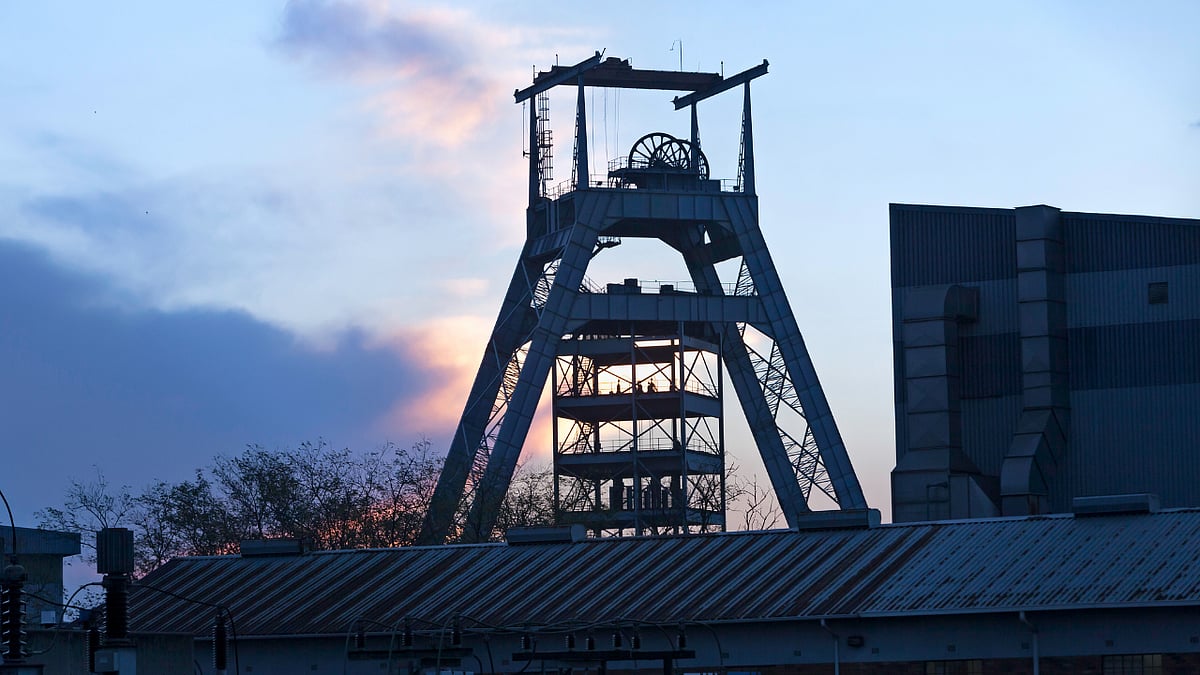
The latest report in Dr Duarte da Silva’s Gold Papers series says the Witwatersrand is one of the world’s great uranium provinces hiding in plain sight. An estimated 600,000 tonnes of uranium sit on surface in the region’s gold tailings, a by-product discarded for decades while prices were too low to justify recovery. With uranium having re-rated roughly fourfold since 2020, and South Africa’s own energy plan calling for new nuclear capacity, the paper makes the case that recovering this second metal could subsidise gold-mine economics, attract a new class of nuclear-fuel buyers, and even help remediate radioactive acid mine drainage.
By Dr Duarte da Silva
THE OTHER METAL IN THE REEF
The Witwatersrand is one of the great uranium provinces on earth, and the uranium sits in the same reefs and the same dumps as the gold. Recovered as a by-product in a nuclear-hungry world, it makes a tonne mined for gold pay twice — and brings a buyer the gold story has never reached.

THE FORGOTTEN PROVINCE
I. A uranium province that remembers only the gold
South Africa thinks of itself as a gold country that occasionally produced some uranium. The geology says the reverse is just as true: the Witwatersrand is one of the great uranium provinces on earth, and it always has been. The uranium is not somewhere else, in some other rock, in some other district. It is in the same conglomerate reefs as the gold, laid down by the same ancient rivers, lifted by the same shafts and dumped on the same tailings. Every tonne the basin ever mined for gold contained uranium too. The country simply chose, for seventy years, to remember only one of the two metals it was digging.
This is not theory. Since 1952, South Africa’s gold mines have produced and exported on the order of 240,000 tonnes of uranium as a by-product of gold — enough, on its own, to have made the country a serious uranium producer in any other framing. The uranium rode out of the same plants as the gold, was sold into the nuclear fuel cycle, and was treated throughout as an afterthought to the metal everyone cared about. When the uranium price was low, the recovery circuits were throttled back or switched off and the uranium was simply left in the waste. The basin did not stop being a uranium province. The accountants just stopped counting the uranium.
The Witwatersrand is one of the great uranium provinces on earth. The uranium is in the same reefs, the same shafts and the same dumps as the gold. The country chose, for seventy years, to remember only one of the two metals.
EXHIBIT A · THE METAL ON THE DUMP
II. Six hundred thousand tonnes, lying in the open
Begin with the number that should reframe the entire story of reprocessing the Witwatersrand tailings. The Witwatersrand gold tailings — the dumps long argued to be a stranded gold resource lying on surface — are estimated to hold on the order of 600,000 tonnes of uranium, spread across roughly 400 square kilometres of the basin. That uranium is not buried at depth or locked in some inaccessible structure. It is on surface, in the open, in the same sand the gold-retreatment plants are already processing. The primary reef ran at up to around 200 parts per million uranium; the tailings carry the fraction that the old plants, built for gold and indifferent to uranium, threw straight back onto the dump.
It was left there for one reason, and it is the reason that has now reversed. Uranium was cheap. For most of the last forty years the metal traded too low to justify the extra circuit, the extra licence and the extra handling that by-product recovery requires, so operators took the gold and discarded the uranium with the rest of the waste. The dumps are, in effect, a uranium resource created by decades of deciding uranium was not worth the bother. Every surface-retreatment operation in the basin is moving, screening and re-depositing sand that contains a second strategic metal — and, on the current circuits, mostly putting that metal back where it found it.
The same dumps long called a stranded gold resource hold an estimated 600,000 tonnes of uranium — on surface, in the open, left there only because uranium was once too cheap to bother with.
EXHIBIT B · THE RE-RATING
III. The afterthought became a strategic input
What changed is the price, and the reason behind the price. Uranium has re-rated violently. It traded around twenty dollars a pound in 2020 — near the lows that justified abandoning by-product recovery — and has since run to multi-year highs on the back of the nuclear renaissance, touching above 100 dollars a pound in January 2026 before settling around the mid-eighties. The by-product nobody bothered to recover has roughly quadrupled in value, and it has done so for a structural reason that is not going to reverse: the world has decided, after two decades of hesitation, that it cannot decarbonise or secure its grid without nuclear power, and nuclear power runs on uranium that has been chronically under-supplied.
Spot uranium has re-rated roughly fourfold since 2020 — from around $20 a pound to the mid-$80s, with an early-2026 peak above $100 — on the global nuclear build-out. The metal South Africa discards on its dumps is now a strategically scarce energy input.

And here the argument turns from interesting to pointed, because South Africa is not a bystander to this. The country’s own Integrated Resource Plan, in its 2025 form, sets out a major expansion of generating capacity that includes new nuclear — on the order of several gigawatts of it — as part of how the state intends to keep the lights on. A country that is planning to build new reactors needs uranium to fuel them. And that country is sitting on roughly 600,000 tonnes of the stuff, on surface, on its own dumps, which it is currently declining to recover. The by-product that was an afterthought when uranium was twenty dollars is now, simultaneously, a re-rated export commodity and a domestic energy-security input that the state will otherwise have to import. South Africa is preparing to buy uranium fuel for power stations it is building on top of a basin that is one of the largest uranium resources on earth.
And there is a geopolitics to uranium that makes a South African source disproportionately valuable to exactly the new reader this paper is written for. The supply is dangerously concentrated. Kazakhstan alone produces around 40 per cent of the world’s mined uranium; Russia dominates the conversion and enrichment that turn raw oxide into reactor fuel; and the next obvious source, Niger — a quarter of Europe’s uranium until a 2023 coup — now sits under a junta courting Moscow. Since the war in Ukraine, Western utilities have spent two years trying, urgently and expensively, to diversify away from Russian and Central Asian material. A large, near-surface uranium resource in South Africa — non-Russian, non-Kazakh, in a country with a seventy-year production record and Western-facing capital markets — is precisely the supply those buyers are now scouring the world to find. The metal on the Reef is not just re-rated. It is strategically located.
South Africa is preparing to build new reactors and import the uranium to fuel them — while sitting on 600,000 tonnes of it, on surface, on its own dumps, which it declines to recover.
EXHIBIT C · WHERE SOUTH AFRICA STANDS
IV. A first-rank resource, an eleventh-rank producer
Place the country on the world table, because the ranking is its own argument. Measured by identified recoverable resource, South Africa holds on the order of 320,000 tonnes of uranium — about five per cent of the global total, enough to stand around seventh in the world, behind only Australia, Kazakhstan, Canada, Namibia, Russia and Niger. That is the conservative reading. It counts only what the international Red Book accepts as economically recoverable, and it sits beneath a contained tailings endowment estimated near 600,000 tonnes that the official figure does not fully carry. On resource, South Africa is not a minor name on the uranium map. It is a first-rank uranium country that the world — and the country itself — has filed under gold.
Now set the output beside the endowment, because that is where the story turns. South Africa produced something on the order of 200 tonnes of uranium in 2022 — roughly a third of one per cent of world supply, around eleventh on the producer table, a rounding error against Kazakhstan’s thirty-nine per cent, Canada’s twenty-four and Namibia’s twelve. A country that ranks around seventh in the ground ranks around eleventh out of the plant. And the eleventh-place figure is not a ceiling the geology imposed. It is a position the country chose. South Africa mined, milled and exported some 240,000 tonnes of uranium across the second half of the twentieth century; it has run this metal at a hundred times its current rate, from the same basin, within living memory. Output did not fall because the resource ran out. It fell because the price fell and the circuits were switched off.
South Africa ranks around seventh in the world on the uranium in its ground and around eleventh on the uranium out of its plants. The distance between those two numbers is not geology. It is a price that fell and a circuit that was switched off.
The comparison that should sting sits across one border. Namibia holds a uranium resource broadly comparable in scale to South Africa’s, and it turned that endowment into being the third-largest uranium producer on earth — around six thousand tonnes a year, drawn from Rössing and Husab, two dedicated open pits in the desert. Same region, same era, a fraction of the industrial base and the fuel-cycle plumbing — and Namibia is a uranium power, while South Africa, holding more contained uranium in its dumps alone than Namibia holds in total, sits eleventh. The difference is not the rock. It is that Namibia built mines for the metal, and South Africa decided, year after year for four decades, that the uranium in its gold waste was not worth the circuit. The competitive position is there to be reclaimed. It is being declined.

Namibia holds a similar resource and made it the world’s third-largest uranium output. South Africa holds more in its dumps alone — and ranks eleventh. A first-rank endowment, a near-last-rank performance, in one country, in one lifetime.
EXHIBIT D · PAY TWICE
V. The co-product flip
Now the mechanism that makes this matter to a gold investor, not just an energy one. At a re-rated uranium price, a tonne of reef or tailings mined for gold carries a second, independently priced revenue stream — and that changes the economics of the gold operation it travels with. This is not a hypothetical circuit. South Africa already runs it. At Vaal River, the reef from Moab Khotsong, Great Noligwa and Kopanang is milled at the Noligwa gold plant and routed through the South Uranium Plant, which extracts uranium oxide by reverse leach and produces yellowcake for the fuel cycle. The plumbing exists, the licences exist, the skills exist. The country has simply run the circuit at minimum while uranium was cheap.
The numbers are already showing the flip. Harmony, which owns Moab Khotsong, reported uranium sales up 79 per cent year-on-year to about 612,000 pounds in its 2024 financial year, generating roughly 866 million rand of revenue — from a by-product, on a gold operation, almost as an aside. That is the co-product flip in miniature: as uranium re-rates, a stream the operator barely bothered to report becomes a material contributor to the same mine’s economics. Multiply that logic across the retreatment sector — DRDGold and the surface operators already understand uranium circuits — and the point is clear. In a basin where the gold plants are running anyway, the uranium is incremental margin on tonnes that are being moved regardless. It does not have to carry its own mining cost. The rock was going to be processed for gold; the uranium is what the same pass through the plant can also capture.
And the infrastructure runs deeper than any single plant. The yellowcake from the South Uranium Plant goes to Nufcor, where it is calcined and packed as uranium oxide for shipment to the converters — a piece of fuel-cycle plumbing most uranium-producing nations would have to build from scratch. South Africa already has it, because it has been a serious uranium producer before: output peaked in the 1980s, and the same Witwatersrand uranium once fed a state nuclear programme. None of that history is comfortable, but the industrial point is unavoidable. The country has mined, milled, packed and exported Witwatersrand uranium at scale, through a full domestic fuel-cycle chain, for seventy years. The capability to recover the second metal is not speculative or foreign-licensed. It is dormant, and it is already built.
As uranium re-rates, a stream the operator barely bothered to report becomes material to the same mine. In a basin where the gold plants run anyway, the uranium is incremental margin on tonnes moved regardless.
EXHIBIT E · THE LIVE TEMPLATE
VI. Beisa, where the second metal leads
There is one place on the Reef where the relationship inverts and uranium is not the by-product but the headline, and it is worth examining because it is live, listed and concrete. The Beisa Reef, in the Free State’s Welkom goldfield, is being developed by Neo Energy Metals around a resource of about 117 million pounds of uranium and 5.4 million ounces of gold across some 25 kilometres of strike — ground acquired from Sibanye-Stillwater, which had it as a gold-era asset and treated the uranium as incidental. Beisa is the shallowest deposit in the Welkom field, which is the whole point: it can be reached by shallow lateral mining at a few hundred metres rather than a deep new shaft, which means early cash rather than a decade of capital.

Beisa is the exception that proves the rule for the rest of the basin. It shows that the Witwatersrand uranium is real enough, and large enough, to stand up a project on its own account — and that where the gold and uranium sit together in mineable, shallow ground, the combined deposit is worth far more than the gold figure alone that the previous owner booked it at. The wider basin is the by-product case; Beisa is the standalone one. Both point the same way: there is a second metal in this rock, and the market is only now pricing it.

Sibanye held Beisa as a gold asset and called the uranium incidental. At today’s prices the two metals together are worth above thirty billion dollars in the ground — and the uranium is the half nobody was counting.
EXHIBIT F · WHAT IT DOES TO THE RESTART
VII. A second metal, and a second buyer
Seen whole, the uranium changes the case in two ways no single-metal argument can. The first is financial. Every restart case for reprocessing or reopening turns on the economics of doing so at the gold price; add a uranium stream that re-rates on its own, separate cycle, and the same tonne clears a lower bar. A marginal gold-only retreatment project can become a comfortable gold-and-uranium one without a single change to the rock — because the second metal pays part of the cost of recovering the first. Uranium does not just sit alongside the gold thesis. It subsidises it.
The second is the reader. The case has usually been addressed, in the end, to someone who cares about gold — the bullion investor, the gold miner, the central bank holding bars. Uranium brings an entirely different audience to the same basin: the utility that needs fuel, the nuclear-fuel trader, the energy-security fund, the transition investor who will not touch a gold story but will fund a low-carbon-power one. For that reader the Witwatersrand is not a gold play at all; it is a large, near-surface, politically domestic uranium resource in a world short of exactly that, attached to a state that is itself about to become a uranium buyer. A gold-only argument could never reach that desk. The uranium can — and it points them at the same dumps.
And there is a third dividend, environmental. The uranium in the tailings is not inert. It is part of what makes Witwatersrand acid mine drainage radioactive as well as acidic, leaching into the water and soil of Soweto and the West Rand — a documented public-health hazard the state is paying to contain in perpetuity. Recovering the uranium does not only produce fuel and revenue; it strips a radioactive contaminant out of the very dumps that are poisoning the water table. The same retreatment pass that lifts the gold and captures the uranium also remediates a hazard the public otherwise funds forever. Gold, nuclear fuel, and a cleaner water table, from one movement of the same sand: it is the circular case for the basin, with a second strategic metal folded into it.
Uranium does not sit alongside the gold thesis. It subsidises it — and it brings a buyer a gold-only argument could never reach: the utility, the fuel trader, the energy-security fund, pointed at the same dumps.
EXHIBIT G · IS THE METAL ON THE DUMP COMMERCIAL?
VIII. The grade question
Ask the question that decides everything, because the rest of the argument leans on it: is the uranium on the dump rich enough to pay? The grade answers more favourably than the sceptic expects. Witwatersrand tailings carry uranium at around 100 parts per million on average, across many of the dams above that, occasionally past 200 — concentrations a recent resource study notes sit above those of some conventional uranium ore deposits. This is not background. Ordinary crustal rock runs at two to four parts per million; the dumps run at twenty-five to fifty times that, because they are the milled residue of an orebody that was unusually uraniferous to begin with. Set the tailings against the working uranium industry and the grade is not an embarrassment. Uranium is already pulled commercially as a by-product from porphyry copper mines running at only tens of parts per million. On concentration alone, the dump sand sits inside the band the industry already mines.
And the tailings carry an advantage no orebody in the ground can offer: the most expensive step is already paid for. The largest single cost in uranium mining is breaking rock out of the earth and grinding it fine enough to free the metal. On the dumps that work was done decades ago — by the gold industry, on the gold’s account. The sand is already mined, already milled, already sized, already sitting on surface behind a fence. What remains is the leach and the recovery, and South Africa has run precisely that on Witwatersrand tailings before, by mild acid leach and resin-in-pulp. The qualifier is recovery rate: a mild leach lifts something like forty per cent of the contained uranium, not the whole of it — which is one reason the country’s official recoverable resource, near 320,000 tonnes, sits well below the roughly 600,000 tonnes the dumps are estimated to contain. That gap is not a contradiction in the numbers. It is the commercial answer written in metal: a large share is recoverable now, a large share is not yet, and the uranium price decides where the line between them falls.
The dumps run at around 100 parts per million uranium, in places past 200 — inside the band conventional mines already work, with the mining and milling already paid for. The question was never whether the metal is rich enough. It is how much of it the leach gives back.
So is the above-ground uranium really commercial? Sold on its own account, dug from the dump for its own sake, mostly not — the recovery is partial, the grade rewards scale over selectivity, and the regulatory load on a radioactive stream is real. Lifted as a by-product from sand a gold plant is already moving, at a uranium price that has quadrupled since 2020, increasingly so — which is exactly the circuit the country already runs at Vaal River and is studying across the retreatment sector. The commerciality of the dump uranium does not turn on whether the metal is good enough, because it is. It turns on whether the metal rides out of the plant with the gold or goes back onto the dump with the waste. At today’s price, on tonnes that are being processed anyway, the arithmetic has crossed the line.
EXHIBIT H · WHAT THIS IS NOT
IX. The real limits of the second metal
Discipline the claim, because the uranium case attracts overstatement even faster than the gold one. The first and most important caveat is the one the whole co-product argument rests on: outside a standalone deposit like Beisa, by-product uranium economics depend on the gold plant running anyway. The uranium is incremental margin on tonnes that are already being moved and milled for gold; it is not, on the dispersed tailings, a reason to mine rock that the gold alone would not justify. Take the gold operation away and most of the tailings uranium goes back to being too low-grade and too dispersed to chase on its own. The uranium strengthens the gold case; it does not replace it.
And the rest of the caveats are real. Uranium is radioactive, which means recovery carries regulatory weight a gold circuit does not — National Nuclear Regulator licensing, handling, transport, water and tailings controls that add cost and time. The 600,000 tonnes is a contained, in-ground estimate, not a recoverable reserve; much of it is low-grade and a meaningful fraction may never be economic to extract. None of these is a reason to dismiss the metal — South Africa has recovered Witwatersrand uranium commercially for seventy years, so the path is proven, not speculative — but they are reasons to be exact. The claim is not that the dumps are a uranium mine waiting to be switched on. It is that a real, large, strategically scarce second metal sits in rock the country is already handling for gold, that it now re-rates on its own account, and that ignoring it is leaving money — and fuel — on the dump.
Outside Beisa, the uranium is incremental margin on a gold plant running anyway. It strengthens the gold case; it does not replace it. State that plainly, and the rest of the argument holds.
THE VERDICT
X. The endowment is two metals
Assemble it. The Witwatersrand is one of the great uranium provinces on earth. It has produced a quarter of a million tonnes of the metal already, and holds perhaps 600,000 more in tailings on surface, in the same dumps long called a stranded gold resource. Uranium has re-rated fourfold and is now both a scarce export and a fuel the country needs for the reactors its own energy plan intends to build. The circuits to recover it exist and are running at Vaal River; the co-product revenue is already showing up, growing, in a gold producer’s accounts; and at Beisa the second metal is large enough to lead a project on its own. Every part of the machinery is in place except the decision to treat the rock as carrying two metals instead of one.
That is the reframe. The Witwatersrand endowment is not a single mispriced metal that South Africa abandoned, but two — a gold resource the world is short of, wrapped around a uranium resource the world is also short of, in the same reefs and the same sand, in a country preparing to import the very fuel it is standing on. The tonne mined for gold can pay twice. The basin everyone agreed to call finished is not even finished with its first metal, let alone its second. South Africa is leaving the fuel for its own power stations lying on the dump — in the rock it calls exhausted of gold.
Sign up for your early morning brew of the BizNews Insider to keep you up to speed with the content that matters. The newsletter will land in your inbox every morning on weekdays. Register here.
Support South Africa’s bastion of independent journalism, offering balanced insights on investments, business, and the political economy, by joining BizNews Premium. Register here.
If you prefer WhatsApp for updates, sign up to the BizNews channel here.
Leave a Reply