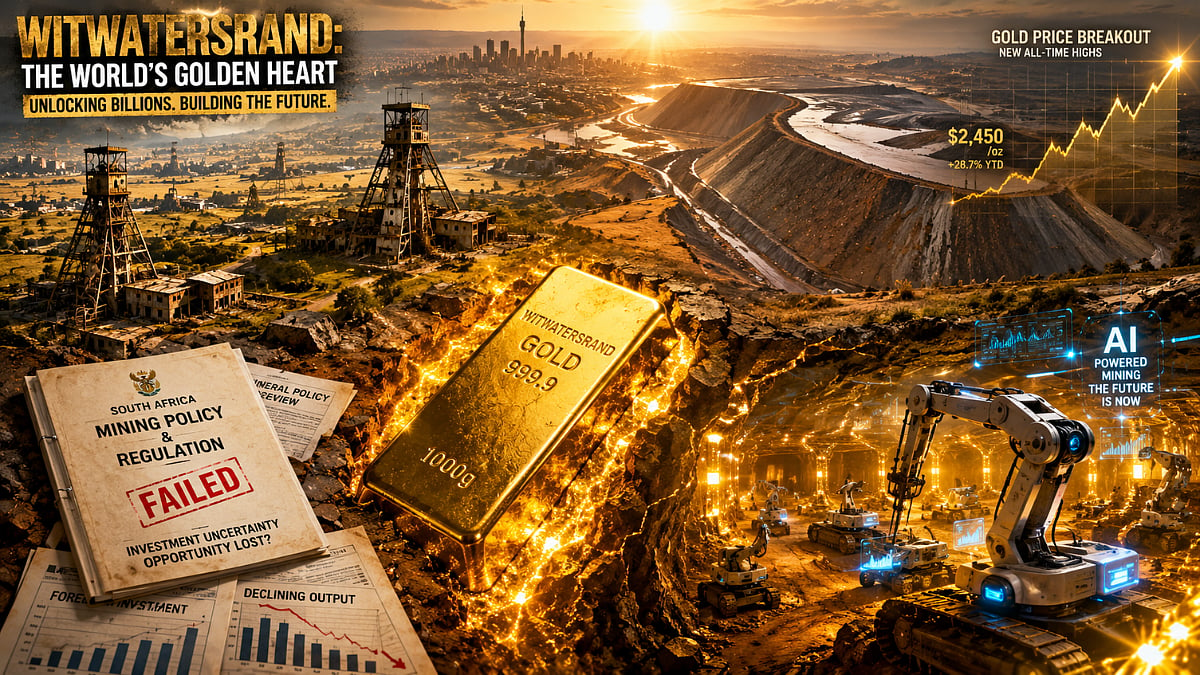
South Africa sits above the world’s largest remaining gold geological endowment. In 2025, it spent R738 million exploring it. Australia spent seventy times more — on geology a fraction as prospective. That ratio, argues Dr Duarte da Silva of Northbound Processing, is not a market outcome. It is a policy verdict. In a meticulously sourced indictment, da Silva traces two decades of compounding institutional failure — government’s regulatory inconsistency, the investment community’s quiet complicity, and the looming threat to the one sector that actually works: tailings retreatment. This is Paper Two of Three. Paper Three promises the architecture of redemption.
By Dr Duarte F da Silva
Australia spent the equivalent of more than R50 billion exploring for gold in the same year. On a geological endowment that is, by the most generous comparative assessment, perhaps a fifth of South Africa’s. Canada spent R40 billion. The United States spent R25 billion. Jurisdictions with a fraction of the prospectivity, a fraction of the geological knowledge base, and none of the 140-year production track record that tells you — with a confidence available nowhere else on earth — that the gold is there.
The ratio is approximately seventy to one. Australia spends seventy rand for every one rand South Africa spends on geology that is less prospective, at prices that make both jurisdictions attractive, using technology that grows more powerful every year.
That ratio is not a market outcome. Markets do not produce outcomes like that when the underlying asset is what the Witwatersrand is. That ratio is a policy verdict. And the policy that produced it is still in place.
R738 million. On the world’s largest gold endowment. In the most extraordinary price environment in modern history. Australia spent seventy times more. On geology that is a fraction as prospective. That is not a market outcome. That is a verdict.
1.WHAT IS ACTUALLY THERE
The standard account of South Africa’s gold position goes like this: the country produced 1,000 tonnes annually at its peak in 1970, one quarter of everything mined on earth, but the shallow high-grade reefs are exhausted, what remains is deeper and lower-grade, and the physics of the Witwatersrand Basin finally caught up with us. Production has fallen 90% from peak. The story is over.
This account is partially true and almost entirely misleading. It conflates the exhaustion of the easiest-to-reach material with the exhaustion of the resource itself — which is the geological equivalent of concluding that a library has no more books because the bottom shelf has been cleared.
Peer-reviewed research published in the South African Journal of Geology estimates that 48,100 tonnes of gold remain underground in the Witwatersrand Basin. That figure — 48,100 tonnes — is almost exactly equal to the 50,200 tonnes extracted since 1886. The geological system that produced 40% of all the gold ever mined in human history still contains, at documented minimum, roughly what it has already given up.
At a gold price of US$4,300 per ounce, that documented minimum represents a gross resource value in the hundreds of billions of dollars. And it is a minimum — not a central estimate, not a best case — because of a methodological reality that must be named plainly.
The 48,100 tonne figure represents the gold that has been looked for, at the depths that made economic sense to explore, with the technology and price assumptions of the era when the looking was done. Nobody drilled systematically at 5,000 metres when gold was US$400 per ounce and the shallower material was abundant. The resource estimate is bounded by the exploration investment that generated it — and that investment was rationally constrained by economic assumptions that no longer exist.
The geophysical data — seismic reflection surveys, borehole logs acquired for geotechnical rather than resource purposes, structural geological mapping — shows reef-like structures continuing to depths well below current drilling. The geological model of the Witwatersrand does not predict that the reefs stop at 4,000 metres. They continue on the same dip trajectory, into ground that has never been systematically characterised.
Barberton — the proof that endurance is possible
The Witwatersrand is not the whole story. The Barberton Greenstone Belt in Mpumalanga is a completely different geological system — 3.5 billion years old, one of the oldest exposed terrains on earth, hosting orogenic gold in hydrothermal shear zones rather than sedimentary conglomerate reefs. Pan African Resources operates three underground mines there: Fairview, Sheba, and New Consort.
Fairview has been in continuous production since 1886. One hundred and forty years. The same year as the Witwatersrand discovery. Still producing. Still economic. Not because it has been lucky — because it has been worked intelligently through every price cycle, taking what the economics of each era could justify and leaving the rest for later.
Beyond Barberton, the Pietersburg Greenstone Belt in Limpopo, the Murchison Belt, the Giyani Belt — prospective geological systems with documented surface and shallow gold expressions that have never been followed to depth with modern methods at current prices. South Africa is not a one-geological-system story.
The surface resource — and the gold that processing leaves behind
Above ground, a further approximately 1,600 documented tonnes sit in surface tailings across Gauteng — the residue of 140 years of processing, discarded because the recovery technology of each era could not extract it economically.
A Stellenbosch University study published in Scientific Reports identified up to 420 tonnes of that material locked in pyrite and arsenian pyrite — invisible to conventional carbon-in-leach processing, inaccessible to standard extraction. Not permanently inaccessible. Inaccessible to the technology that was available when the processing decisions were made. The BIOX bacterial oxidation process — developed and commercialised in South Africa at Fairview mine in the 1980s, now operating commercially on four continents — was specifically designed to liberate gold from exactly this sulphide matrix. The technology to recover it exists. It was invented here.
The geological system that produced 40% of all the gold ever mined in human history still contains, at documented minimum, roughly what it has already given up. The upper bound has never been established. Nobody looked hard enough because nobody needed to — until now.
2.THE WORLD IS RUNNING OUT OF NEW GOLD
While South Africa has been declining to look for the gold it has, the rest of the world has been looking elsewhere — and finding progressively less.
The world’s significant gold discoveries — deposits of more than two million ounces — peaked in the late 1980s and early 1990s. Since 2000 the average size of new gold discoveries has fallen by roughly 60%. The time between discovery and first production has extended from around 12 years in the 1990s to more than 17 years now. Global exploration spend peaked at approximately US$8 billion annually in 2012 and has not recovered to that level despite a gold price that has more than doubled since.
The supply consequence is already visible. Global gold mine supply has been essentially flat since 2018 — hovering between 3,300 and 3,600 tonnes per year — despite the gold price more than doubling over the same period. That is a telling signal. In any normal commodity a doubling of price produces a supply response within three to five years. Gold has not responded because the industry cannot find deposits quickly enough, permit them, and build them fast enough to grow output materially. The pipeline is empty. The discoveries are not coming.
The World Gold Council estimates that the industry needs to bring approximately 100 million ounces of new production online over the next decade just to offset depletion at existing mines. The discovery pipeline does not support that. Not remotely.
This is the context in which South Africa’s geological endowment must be understood. Not as a legacy asset in a mature sector — but as the world’s most significant remaining documented gold resource at the moment when the global supply picture is the tightest it has been in the modern era.
Global gold mine supply has been flat since 2018 despite the price more than doubling. The discoveries are not coming. The pipeline is empty. And South Africa — sitting on the world’s largest remaining endowment — spent R738 million looking for more of it.
3.THE CURRENCY THAT FORGOT WHAT IT WAS
There is a conversation about the rand that the South African financial community has not had — because it requires accepting a premise that most participants find uncomfortable: that the rand’s current valuation may represent one of the largest currency mispricings in the world right now.
The rand was not always what it is today — a generic emerging market risk currency, volatile against the dollar, chronically weak, repriced on global risk sentiment and political news flow. For most of its modern history it was something else. It was, in practice if not in law, the world’s gold currency. South Africa’s export earnings, its foreign reserve accumulation, its balance of payments were so dominated by gold that the metal and the currency moved together.
That relationship was severed. Not by geology. By the production collapse. As output fell from 1,000 tonnes to 100 tonnes over five decades, gold’s share of South African export revenue fell from dominance to relevance to near-irrelevance. The rand decoupled. It became a commodity basket currency — then a political risk currency — then the thing it is today: an emerging market proxy that professional currency traders describe, with affectionate contempt, as one of the most liquid expressions of global risk appetite available in the developing world.
Consider Norway. The krone is not valued as a generic Scandinavian currency. It is valued as the currency of a sovereign wealth fund built on a resource the world needs. The Norwegian state took its North Sea oil endowment seriously — institutionally, politically, financially — and over thirty years the krone was transformed from a minor Nordic currency into one of the world’s most stable monetary instruments. Not because Norway invented oil. Because it sat above a disproportionate share of a resource the world needed and managed that position with institutional seriousness.
South Africa’s geological position relative to global gold endowment is more dominant than Norway’s position relative to global oil endowment ever was. The Witwatersrand has produced 40% of all gold ever mined in human history from a single geological system. The remaining characterised endowment, at minimum, equals what has been extracted. And gold’s strategic importance — as a monetary reserve asset in a world actively diversifying away from dollar dependence — is rising faster than at any point since Bretton Woods.
The rand reflects none of this. It is priced as though the Witwatersrand were a depleted historical curiosity rather than the world’s most significant remaining gold geological endowment at the most propitious moment in gold’s modern history.
The rand was once the world’s gold currency. The gold is still there. The currency is priced as though the geological system beneath it is a historical
footnote rather than the largest remaining gold endowment on earth at the most important moment in gold’s monetary history since Bretton Woods.
4.THE TECHNOLOGY ARGUMENT — WITHOUT THE CONSERVATIVE BIAS
Every major technology transition in mining has been underestimated by the incumbents living through it. Mechanised drilling, in the 19th century, did not marginally improve on hand drilling — it collapsed the cost per metre by an order of magnitude. Cyanide leaching, arriving in the 1890s, made the entire Witwatersrand economically viable: reef that had been dismissed as too low-grade to work at scale became the foundation of an industry. And the BIOX process unlocked a whole global category of refractory deposit that conventional processing had written off entirely.
Each of these transitions was described, before it happened, in the conservative language of incremental improvement. Each of them, in retrospect, was a phase change. The autonomous and AI transition in mining is a phase change of the same order. Possibly larger.
What removing the human from the deep stope actually means
Current operating depth for human underground gold mining — the practical ceiling beyond which occupational health, seismic risk, cooling cost, and logistics combine to make continuous human operation unsustainable — is approximately 4,000 to 4,200 metres. Mponeng is at that ceiling now. The rock temperature before cooling at that depth exceeds 65°C.
Remove the human from the stope and three of those four constraints change structurally. Heat does not constrain a machine the way it constrains a human. The cooling requirement drops dramatically because you are not maintaining a survivable wet bulb temperature for hundreds of workers several kilometres underground. Ventilation requirements fall by perhaps 70%. The seismic risk calculus changes entirely — damaged equipment is insurable and replaceable; injured workers are neither. The depth ceiling for autonomous systems is not 4,200 metres. It is somewhere between 5,500 and 6,500 metres on a fifteen to twenty-year technology horizon.
Labour represents approximately 50% of deep level all-in sustaining costs. Ventilation and cooling represent a further 20 to 25%. A fully autonomous deep level operation does not marginally reduce those costs. It structurally eliminates the largest portion of them. The all-in sustaining cost profile of a deep autonomous operation is a different cost curve entirely — one that makes reef currently characterised as marginal look exceptional, and reef currently characterised as inaccessible look like the next frontier.
The conservative technology assumption is itself a risk. Every previous mining technology transition was underestimated by the people living through it. The autonomous transition is a phase change, not an increment. The depth ceiling for machines is not the depth ceiling for humans — and in the Witwatersrand, that distinction is worth hundreds of billions of dollars.
5.HOW IT HAPPENED — THE COMPOUNDING FAILURE
This is an account of institutional behaviour — across government and the investment community simultaneously — that produced a compounding outcome neither party fully intended and neither has fully acknowledged.
The mechanism that produced R738 million in annual exploration spend on the world’s largest gold endowment is not a single policy error. It is a pattern — a repeating structure of
intervention that has appeared, in different forms, across two decades and multiple policy domains — always targeting the thing that works, always dressed in the language of transformation and national interest, always producing the opposite of its stated objective.
The government failures — in sequence
The MPRDA in 2002 was not wrong in principle. The custodianship of mineral resources for the national benefit is defensible policy and it is the right framework for a country whose mineral endowment belongs to its people. The execution was the failure. A framework that vested discretionary authority over commercial decisions in the Minister — rather than in transparent, published, consistently applied rules — created from day one a system in which political and administrative relationships determined outcomes that should have been determined by criteria.
The mining charter revisions compounded it. Three material changes to the fundamental equity structure of the sector in fifteen years. Each change made while operators who had structured transactions around the previous requirements were still executing them. The investment community does not require perfect policy. It requires consistent policy. A rule that changes before the investment cycle it governs is complete is not a rule. It is a recurring negotiation — and long-cycle capital does not commit to recurring negotiations.
The Regulation 28 amendment in 2022 was a different department making a different mistake. National Treasury raised the offshore allocation ceiling from 30% to 45% at precisely the moment when the gold price environment was beginning to make domestic productive assets most attractive. The Finance Minister has since acknowledged publicly that this was a mistake. The acknowledgement has not been followed by reversal. An admission without correction is not accountability. It is the appearance of accountability in the absence of its substance.
The proposed MPRDA extension to tailings retreatment — gazetted in May 2025 — is the most damaging iteration of the pattern yet, because it targets something unambiguously working. Not a struggling sector, not a marginal operation, not a speculative proposition. A world-leading industry generating exceptional margins, attracting fresh capital, remediating a century of environmental liability, and doing all of this without asking government for anything except to be left alone.
Four failures. Two departments. Two decades. Each individually explicable. Collectively: the systematic destruction of the conditions under which the world’s largest gold endowment could be developed — at the moment in history when developing it would have been most consequential for the country whose asset it is.
The investment community — complicit, not victimised
The investment community’s preferred narrative positions it as the rational responder to government failure — capital going where policy is better, fiduciary duty requiring offshore allocation when domestic conditions deteriorate, nothing personal, just arithmetic. That narrative is partly true. It is mostly self-justification.
When Regulation 28 moved to 45%, R800 billion in retirement capital became eligible for offshore deployment. Some of that move represented genuine diversification. A meaningful portion of it was stampede behaviour — capital following capital out of a market where declining institutional demand had already compressed valuations, producing the very conditions that justified further outflow.
More pointed still: the JSE Top 40 derives more than 80% of its revenues from outside South Africa. Naspers, Glencore, Richemont, British American Tobacco: global enterprises domiciled or listed in Johannesburg. When retirement funds allocated to the JSE Top 40 they
were not investing in South Africa. They were gaining offshore economic exposure through a domestic wrapper — using the local listing to circumvent the spirit of an allocation framework designed to keep capital productively deployed within the economy that granted its tax privileges. This was legal. Its effect on the domestic productive capital pool was identical to taking the money offshore directly.
The compounding mechanism
Neither party can deflect what follows by pointing at the other.
Government’s mining policy failures made South African mining assets less attractive to capital. First order effect. Government’s investment policy failure simultaneously reduced the pool of domestic capital available to invest in those assets even if investors had wanted to. Second order effect. The combination produced a third order effect that neither failure alone would have generated. Valuations compressed faster than either policy change individually would have caused, because falling institutional demand and rising policy uncertainty arrived simultaneously. The compression was not additive. It was multiplicative.
The investors’ response — moving offshore, using JSE-listed international companies as domestic allocation proxies, reducing genuine domestic equity exposure — accelerated the compression further. Which gave government the political cover to point at capital flight as evidence that international investors had decided against South Africa’s transformation agenda. Which reduced the political cost of further regulatory deterioration. Which further justified offshore allocation. The loop closed. Each failure fed the next. The compounding ran in one direction for twenty years.
This is not a story of villains. It is a story of incentives — government officials whose political incentives rewarded regulatory control over commercial outcomes, fund managers whose career incentives rewarded benchmark performance over long-cycle domestic commitment, mining executives whose survival incentives rewarded cost management over geological ambition. Each acted rationally within their own incentive
structure. The aggregate result was the systematic destruction of the world’s most significant mineral development opportunity at the moment when its development mattered most.
6.WHAT IS ABOUT TO BE DESTROYED — AND WHY IT MATTERS MORE THAN THE GOLD
Everything described so far — the geological endowment, the scarcity dynamic, the rand argument, the technology trajectory, the compounding policy failure — is about gold. It is the financial argument, and it is overwhelming on its own terms.
But there is a second argument that runs alongside it and that the proposed MPRDA extension to tailings retreatment puts at risk. It is not a financial argument. It is a positional argument
— about where South Africa stands as global capital reorganises itself around ESG, responsible investment, and circular economy principles. And the position it is about to surrender, if the regulatory pattern holds, is one that took decades to build and cannot be rebuilt quickly once it is gone.
What the tailings sector actually is
Strip away the mining language. Describe what DRDGOLD, Pan African Resources, and the businesses operating in this space are actually doing — in the language that a European ESG investment committee or an Ellen MacArthur Foundation circular economy analyst would use.
They are taking a toxic industrial legacy — acid-generating, heavy-metal-leaching, community-blighting waste dumps that have occupied and contaminated some of South Africa’s most densely populated urban areas for over a century — and converting them into productive assets. Recovering value from material that was discarded. Eliminating environmental liabilities that the state cannot afford to remediate through any other mechanism. Freeing urban land. Reducing acid mine drainage into water systems that communities depend on. Simultaneously generating gold revenue and repairing what extraction left behind.
In the language of the Ellen MacArthur Foundation circular economy framework — adopted as a reference standard by the European Commission, the World Economic Forum, and an increasing number of national governments — this is not adjacent to the circular economy ideal. It is a near-perfect expression of it.
DRDGOLD’s Ergo operation in Germiston is the largest surface gold tailings retreatment facility in the world. Pan African Resources’ Mogale and Soweto projects represent the most significant new capital commitment to responsible gold recovery from legacy waste streams anywhere on earth. The BIOX bacterial oxidation process — developed and first commercialised in South Africa at Fairview mine in the 1980s — is the world’s most widely deployed biotechnology application in gold processing, operating commercially on four continents.
South Africa did not adapt to the global responsible minerals movement. It produced the technology, the operational knowledge, and the commercial proof of concept that the rest of the world is now attempting to replicate.
At the moment when global capital markets are most actively seeking credentialled ESG-compliant resource exposure — when European pension funds are under regulatory pressure to demonstrate responsible investment practice, when the EU Taxonomy is creating premium market access for qualifying activities — South Africa holds a world-leading position in precisely the sector that global capital most wants to own.
The proposed MPRDA extension brings this sector — the world leader, the circular economy proof of concept, the ESG-credentialled responsible recovery industry that South Africa built over decades — within the same discretionary regulatory framework that produced the exploration collapse. Not because it is failing. Because it is succeeding. If this proceeds, South Africa will not just lose the financial returns that tailings retreatment generates. It will surrender the global positional advantage that its operators have spent decades building and that its competitors cannot replicate quickly.
South Africa did not follow the global responsible minerals movement. It created it. The technology, the track record, the proof of concept — all South African. And the government is proposing to regulate it under the framework that collapsed exploration. Not because it is failing. Because it is succeeding.
7.THE VERDICT
South Africa is the custodian of the world’s most significant remaining gold geological endowment. The characterised resource — at minimum — equals everything extracted in 140 years of production. The deep uncharacterised extension may dwarf it. The technology trajectory makes progressively more of it recoverable. The global scarcity of new gold discoveries makes it more strategically valuable with each passing year.
Against this: R738 million in annual exploration spend. A licensing system that approves fewer than 15% of prospecting right applications. A capital market that has exported R800 billion in
retirement savings offshore. An investment community that used the JSE as a post office box for international economic exposure while calling it domestic allocation. A government that has changed the fundamental rules of the sector three times in fifteen years, proposed to regulate the one segment that is working, and acknowledged its investment policy mistake without reversing it.
Read more:
The compounding effect of these simultaneous failures has produced a situation in which the world’s largest gold geological endowment is the most underexplored, underfinanced, and undervalued major mineral asset on earth.
That is either the largest policy failure in South African economic history. Or the largest investment opportunity.
At the current gold price, with the technology trajectory that is visible, and with the global supply picture that the discovery data describes — it is both. Simultaneously.
The question is not whether the asset is real. The geology answers that. The question is not whether the price environment is right. The arithmetic answers that. The question is whether South Africa has the institutional will to stop repeating the pattern that has brought it here — and to build, deliberately and with urgency, the architecture that converts the failure into the opportunity. Paper Three is that architecture.
Sign up for your early morning brew of the BizNews Insider to keep you up to speed with the content that matters. The newsletter will land in your inbox every morning on weekdays. Register here.
Support South Africa’s bastion of independent journalism, offering balanced insights on investments, business, and the political economy, by joining BizNews Premium. Register here.
If you prefer WhatsApp for updates, sign up to the BizNews channel here.
Leave a Reply